|
Type
|
Reference
|
Content
|
|
web
|
www.netzwerk-universitaetsmedizin.de
|

|
|
web
|
github.com
|
Konformität
|
|
web
|
github.com
|
Konformität
|
|
web
|
github.com
|
Allgemeine Anforderungen
|
|
web
|
github.com
|
Must-Support
|
|
web
|
github.com
|
Umgang mit fehlenden Daten
|
|
web
|
www.netzwerk-universitaetsmedizin.de
|
IG © 2019+ NUM-DIZ
.
Package de.medizininformatikinitiative.kerndatensatz.medikation#2027.0.0-ballot basiert auf FHIR 4.0.1
.
Erstellt 2026-09-11
Links: Inhaltsverzeichnis |
QA-Bericht
| netzwerk-universitaetsmedizin.de
| medizininformatik-initiative.de
| Impressum
HL7®, FHIR® and the FHIR flame design are registered trademarks of Health Level Seven International. Their use does not constitute endorsement by HL7.
|
|
web
|
www.netzwerk-universitaetsmedizin.de
|
Links: Inhaltsverzeichnis
|
QA-Bericht
| netzwerk-universitaetsmedizin.de
| medizininformatik-initiative.de
| Impressum
HL7®, FHIR® and the FHIR flame design are registered trademarks of Health Level Seven International. Their use does not constitute endorsement by HL7.
|
|
web
|
www.medizininformatik-initiative.de
|
Links: Inhaltsverzeichnis
|
QA-Bericht
| netzwerk-universitaetsmedizin.de
| medizininformatik-initiative.de
| Impressum
HL7®, FHIR® and the FHIR flame design are registered trademarks of Health Level Seven International. Their use does not constitute endorsement by HL7.
|
|
web
|
www.netzwerk-universitaetsmedizin.de
|
Links: Inhaltsverzeichnis
|
QA-Bericht
| netzwerk-universitaetsmedizin.de
| medizininformatik-initiative.de
| Impressum
HL7®, FHIR® and the FHIR flame design are registered trademarks of Health Level Seven International. Their use does not constitute endorsement by HL7.
|
|
web
|
github.com
|
Woher die Versionen kommen.
Jedes Paket der Tabelle ist direkt in
sushi-config.yaml
( dependencies:
) gepinnt — auch hl7.terminology.r4
(THO) und
hl7.fhir.uv.extensions.r4
, und diese beiden mit Bedacht: Die
Automatik des IG Publishers
liest ausschließlich die eigene
Abhängigkeitsliste dieses Leitfadens;
ohne direkten Pin würde jeder Build stillschweigend das jeweils aktuellste
THO-/Extensions-Release injizieren — eine allein im MII-Meta-Paket gepinnte
Version kann den Build nicht steuern (verifiziert im Publisher-Quellcode des
gepinnten Release). Eine wöchentliche Prüfung warnt, wenn diese beiden Pins
von den Vorgaben des gepinnten Meta-Pakets abweichen; die von einem
konkreten Build verwendeten Versionen stehen in dessen qa-versions.json
.
|
|
web
|
www.iso.org
|
ISO maintains the copyright on the country codes, and controls its use carefully. For further details see the ISO 3166 web page: https://www.iso.org/iso-3166-country-codes.html
Show Usage
-
ISO 3166-1 Codes for the representation of names of countries and their subdivisions — Part 1: Country code
: MII_CPS_Medikation_CapabilityStatement
, MII_CS_Medikation_PZN_Sales_Status_Codes
... Show 16 more
, MII_CS_Medikation_Wirkstofftyp, MII_EX_Medikation_Wirkstoffrelation, MII_EX_Medikation_Wirkstofftyp, MII_IG_Medikation, MII_LM_Medikation, MII_PR_Medikation_Medication, MII_PR_Medikation_MedicationAdministration, MII_PR_Medikation_MedicationRequest, MII_PR_Medikation_MedicationStatement, MII_PR_Medikation_Medikationsliste, MII_VS_Medikation_ASK, MII_VS_Medikation_ATC, MII_VS_Medikation_Fallkontext, MII_VS_Medikation_PZN_Sales_Status_Codes, MII_VS_Medikation_UNII and MII_VS_Medikation_Wirkstofftyp
|
|
web
|
ucum.org
|
The UCUM codes, UCUM table (regardless of format), and UCUM Specification are copyright 1999-2009, Regenstrief Institute, Inc. and the Unified Codes for Units of Measures (UCUM) Organization. All rights reserved. https://ucum.org/trac/wiki/TermsOfUse
Show Usage
-
Unified Code for Units of Measure (UCUM)
: MII_PR_Medikation_MedicationRequest
, Medication/mii-exa-medikation-medication-ass-100
... Show 18 more
, Medication/mii-exa-medikation-medication-caelyx, Medication/mii-exa-medikation-medication-calcium, Medication/mii-exa-medikation-medication-dolomo, Medication/mii-exa-medikation-medication-dolomo-nacht, Medication/mii-exa-medikation-medication-dolomo-tag, Medication/mii-exa-medikation-medication-glucoseloesung, Medication/mii-exa-medikation-medication-propofol, Medication/mii-exa-medikation-medication-rezeptur, MedicationAdministration/mii-exa-medikation-medication-administration, MedicationRequest/mii-exa-medikation-medication-request-caelyx, MedicationStatement/mii-exa-medikation-medication-statement, MedicationStatement/mii-exa-medikation-medication-statement-caelyx, MedicationStatement/mii-exa-medikation-medication-statement-concor, MedicationStatement/mii-exa-medikation-medication-statement-ibuprofen, MedicationStatement/mii-exa-medikation-medication-statement-intravenous-use, MedicationStatement/mii-exa-medikation-medication-statement-offset, MedicationStatement/mii-exa-medikation-medication-statement-periodisches-intervall and MedicationStatement/mii-exa-medikation-medication-statement-zopiclon
|
|
web
|
github.com
|
Expansionsparameter sind Query-Parameter, die an eine ValueSet
-
$expand
-Operation übergeben werden können, um zu steuern, wie das ValueSet
expandiert wird — also wie die vollständige Liste der Codes aus der
ValueSet-Definition erzeugt wird. Die für diesen IG verwendeten
IG-Parameter
sind in
sushi-config.yaml
( parameters:
) deklariert. Ein Modul, das seine Expansionsparameter über ein
CRMI-Manifest pinnt, verlinkt hier zusätzlich die generierte
Parameters
-Ressource (siehe die auskommentierten Manifest-Blöcke in
sushi-config.yaml
und die Seite Metadata Overview, sofern das Modul sie
behält).
|
|
web
|
ncpdp.org
|
Mapping to NCPDP SCRIPT 10.6
|
|
web
|
ig.fhir.de
|
Dosierungsangaben sollen gemäß dem Dosage-Profil aus dem Medication IG DE
erfolgen. Weitere Informationen zur Dokumentation von Dosierungen finden sich im Medication IG DE (STU1)
.
|
|
web
|
ig.fhir.de
|
Dosierungsangaben sollen gemäß dem Dosage-Profil aus dem Medication IG DE
erfolgen. Weitere Informationen zur Dokumentation von Dosierungen finden sich im Medication IG DE (STU1)
.
|
|
web
|
github.com
|
Dieses Modul deklariert keine eigenen SearchParameter-Ressourcen
. Welche Suchparameter unterstützt werden MÜSSEN, ergibt sich aus dem oben dargestellten CapabilityStatement; die Definitionen stammen aus der FHIR-Basisspezifikation und aus der MII-weiten Suchparameterliste des Meta-Moduls
. Die MII-weiten Festlegungen werden dort zentral gepflegt und hier nicht wiederholt.
|
|
web
|
ig.fhir.de
|
Added
: Dependency auf de.fhir.medication
hinzugefügt, Version STU1
.
|
|
web
|
ig.fhir.de
|
Added
: MedicationStatement.dosage
und MedicationRequest.dosageInstruction
verwenden für Dosierungsangaben das Dosage-Profil
aus de.fhir.medication
.
|
|
web
|
ig.fhir.de
|
Fixed
: Dosierungsangaben in Beispielinstanzen sind konform zu de.fhir.medication
STU1
.
|
|
web
|
github.com
|
Added
: (MedicationAdministration|MedicationStatement|MedicationRequest).medicationCodeableConcept
enthält einen Verweis auf UNII (siehe PR #106
).
|
|
web
|
www.ontoserver.mii-termserv.de
|
Added
: Neue ValueSets und Bindings für ATC ( .../ValueSet/mii-vs-medikation-atc
), ASK ( .../ValueSet/mii-vs-medikation-ask
) und UNII ( .../ValueSet/mii-vs-medikation-unii
), die mit dem MII-Terminologieserver
expandiert werden können und damit erweiterte Validierung ermöglichen.
|
|
web
|
www.ontoserver.mii-termserv.de
|
CodeSystem-Ressourcen für ATC und ASK wurden entfernt. Diese können nun über die Service Unit Terminologische Dienste (SU-TermServ) bezogen werden: https://www.ontoserver.mii-termserv.de/
|
|
web
|
github.com
|
Profil MII_PR_Medikation_MedicationRequest: Entfernen der MustSupport-Labels auf MedicationRequest.recorder
und MedicationRequest.detectedIssue
(siehe Issue #96
).
|
|
web
|
github.com
|
Das CodeSystem Chemical Abstracts Service (CAS)
verwendet ab dieser Version die Canonical URL http://terminology.hl7.org/CodeSystem/CAS
statt urn:oid:2.16.840.1.113883.6.61
(siehe Issue #70
).
|
|
web
|
calver.org
|
Die veröffentlichten FHIR-Packages verwenden nun Calendar Versioning (CalVer)
nach dem Schema YYYY.MINOR.PATCH. Damit wird ein Releasezyklus im Jahresrhythmus etabliert. Die Jahresversion (YYYY) zeigt das Jahr an, in dem das Kerndatensatzmodul angewendet wird. MINOR-Versionen werden bei Einführung neuer Funktionen, Erweiterungen oder substantieller Änderungen veröffentlicht. PATCH-Versionen umfassen Bugfixes oder textuelle Korrekturen.
|
|
web
|
github.com
|
Die Benennung der Conformance-Ressourcen und Beispielinstanzen folgt nun einheitlichen MII-Namenskonventionen
.
|
|
web
|
www.ontoserver.mii-termserv.de
|
CodeSystem-Ressourcen für externe Terminologien (ATC, ASK, EDQM etc.) werden nicht mehr in diesem Modul veröffentlicht, sondern sollen bei der Service Unit Terminologische Dienste (SU-TermServ) bezogen werden: https://www.ontoserver.mii-termserv.de/
|
|
web
|
www.ema.europa.eu
|
Soweit möglich sollen Terminologien und eindeutige Codes verwendet werden, die internationalen Standards entsprechen. Für die Arzneimittel und Dosierungsinformationen sind dies die ISO-Standards zur Identification of Medicinal Products (IDMP)
, die vor allem im regulatorischen Kontext implementiert werden. Als IDMP-konforme Terminologien und eindeutige Identifizierungs-Codes werden vorgeschlagen:
|
|
web
|
www.bfarm.de
|
Stoff-Codes des deutschen Arzneimittel-Stoffkatalogs des BfArM (ASK). Es ist abzuklären, wie diese ASK-Nr. via URI/URL über BfArM/DIMDI oder ABDATA (§ 31b SGB V) öffentlich verfügbar gemacht wird. https://www.bfarm.de/DE/Arzneimittel/Arzneimittelinformationen/Arzneimittel-recherchieren/_node.html
|
|
web
|
en.wikipedia.org
|
Unique Ingredient Identifier (UNII)
des US Substance Registration System. Diese ist in Deutschland nicht verfügbar.
|
|
web
|
www.cas.org
|
Eindeutige Schlüssel, die CAS Registry Number
, aus der Chemical-Abstracts-Service-Datenbank (CAS).
|
|
web
|
www.who.int
|
Für die Bezeichnung der Stoffe können die registrierten Substanzbezeichnungen verwendet werden, bei denen es sich in der Regel, aber nicht immer, um die WHO-INNs (International Non-proprietary Names)
handelt. In der MII sollte dabei die deutsche Schreibweise verwendet werden, die in manchen Fällen von der englischen Version leicht abweicht.
|
|
web
|
www.whocc.no
|
Es wird empfohlen, ATC-Codes (Anatomisch-therapeutisch-chemische Klassifikation)
nur unter Vorbehalt für die Codierung von Wirkstoffen zu verwenden, da keine eindeutige Zuordnung eines ATC-Codes zu einer Substanz möglich ist.
|
|
web
|
gitlab.com
|
Herausgeber und Lizenz:
Herausgeber dieses Inhalts ist die Informationsstelle für Arzneispezialitäten – IFA GmbH / Vidal MMI Germany GmbH
, nicht die MII. Für die Nutzung der Rohdaten der Vidal MMI GmbH besteht ein Nutzungsvertrag mit der TMF; die Verwendung ist damit nur innerhalb der Projekte der Medizininformatik-Initiative und des Netzwerks Universitätsmedizin
erlaubt. Dieser Inhalt unterliegt daher nicht
der CC-BY-4.0-Lizenz des übrigen Moduls. Herausgeber- und Lizenzangabe sind wörtlich aus der PZN-Distribution der Service Unit Terminologische Dienste
übernommen.
|
|
web
|
de.wikipedia.org
|
die Pharmazentralnummer (PZN)
. Diese Nummern müssen über eine öffentlich verfügbare URL/URI abfragbar gemacht werden (§ 31b SGB V).
|
|
web
|
standardterms.edqm.eu
|
Standard-Terminologien der EDQM (European Directorate for the Quality of Medicines and Health Care)
„Routes and Methods of Administration" und „Pharmaceutical Dose Forms".
|
|
web
|
applications.kbv.de
|
Alternativ kann die Bezeichnung einer Darreichungsform in Form des IFA-Codes angegeben werden. Vorgaben gemäß KBV Medikationsplan. Schlüsseltabelle: https://applications.kbv.de/S_BMP_DARREICHUNGSFORM_V1.02.xhtml
|
|
web
|
de.wikipedia.org
|
PZN Pharmazentralnummer
|
|
web
|
www.bfarm.de
|
ATC Anatomisch-therapeutisch-chemische Klassifikation
|
|
web
|
www.cas.org
|
CAS registry system
|
|
web
|
standardterms.edqm.eu
|
EDQM Standard Terms
|
|
web
|
unitsofmeasure.org
|
UCUM unitsofmeasure.org
|
|
web
|
www.medizininformatik-initiative.de
|
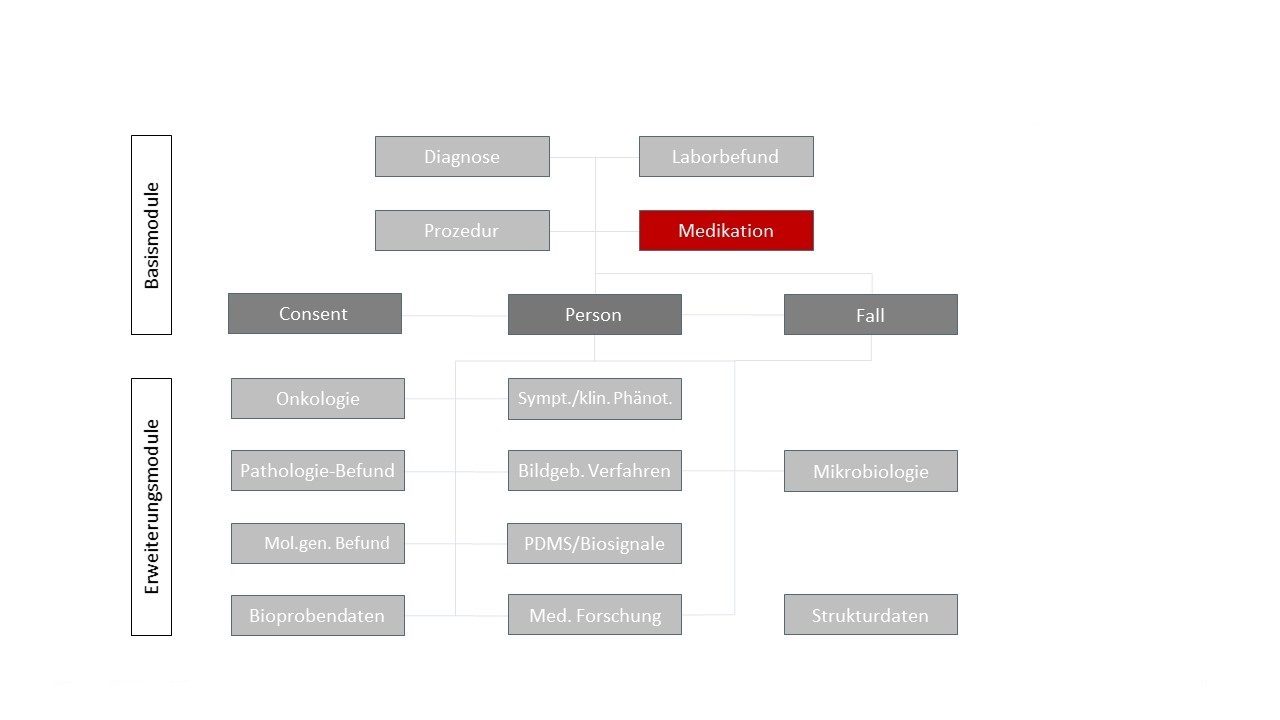
Medikationsdaten sind von zentraler Bedeutung für eine Vielzahl von Fragestellungen, z. B. in der Pharmakovigilanz (AMTS) oder als Ein- und Ausschlusskriterium für Studienkollektive. In den von der AG Data Sharing
zusammengestellten Audit-Abfragen werden sie in den Vorschlägen z. B. des SMITH-Konsortiums
aufgeführt. Zusätzlich wird das Modul MEDIKATION für den konsortienübergreifenden Use Case POLAR — Polypharmazie benötigt.
|
|
web
|
www.kbv.de
|
Bei der Erstellung des Datensatzes zur Dokumentation der Medikation wurden Spezifikationen berücksichtigt, die für den KBV patientenbezogenen Medikationsplan V2.6
bzw. Medikationsplan PLUS
und für die International Patient Summary
erstellt wurden.
|
|
web
|
international-patient-summary.net
|
Bei der Erstellung des Datensatzes zur Dokumentation der Medikation wurden Spezifikationen berücksichtigt, die für den KBV patientenbezogenen Medikationsplan V2.6
bzw. Medikationsplan PLUS
und für die International Patient Summary
erstellt wurden.
|
|
web
|
www.ema.europa.eu
|
Bei Terminologien zur Medikation (Arzneimittel, Substanzen etc.) sollen die ISO-Standards zur Identification of Medicinal Products (IDMP)
berücksichtigt werden.
|
|
web
|
ig.fhir.de
|
Das Modul verwendet den Implementierungsleitfaden Medication DE
von HL7 Deutschland, gepinnt auf
de.fhir.medication 1.0.7
(STU1). Daraus stammt das Profil DosageDE
, auf das MedicationStatement.dosage
und MedicationRequest.dosageInstruction
typisiert sind — Dosierungsangaben folgen damit einer deutschlandweit abgestimmten Struktur statt einer modul-eigenen.
|
|
web
|
github.com
|
Das Modul bleibt bewusst auf 1.0.7, solange 2.0.0 im Ballot ist. Die Übernahme betrifft insbesondere die Dosierungsvorgaben und wird in Issue #107
verfolgt.
|
|
web
|
art-decor.org
|
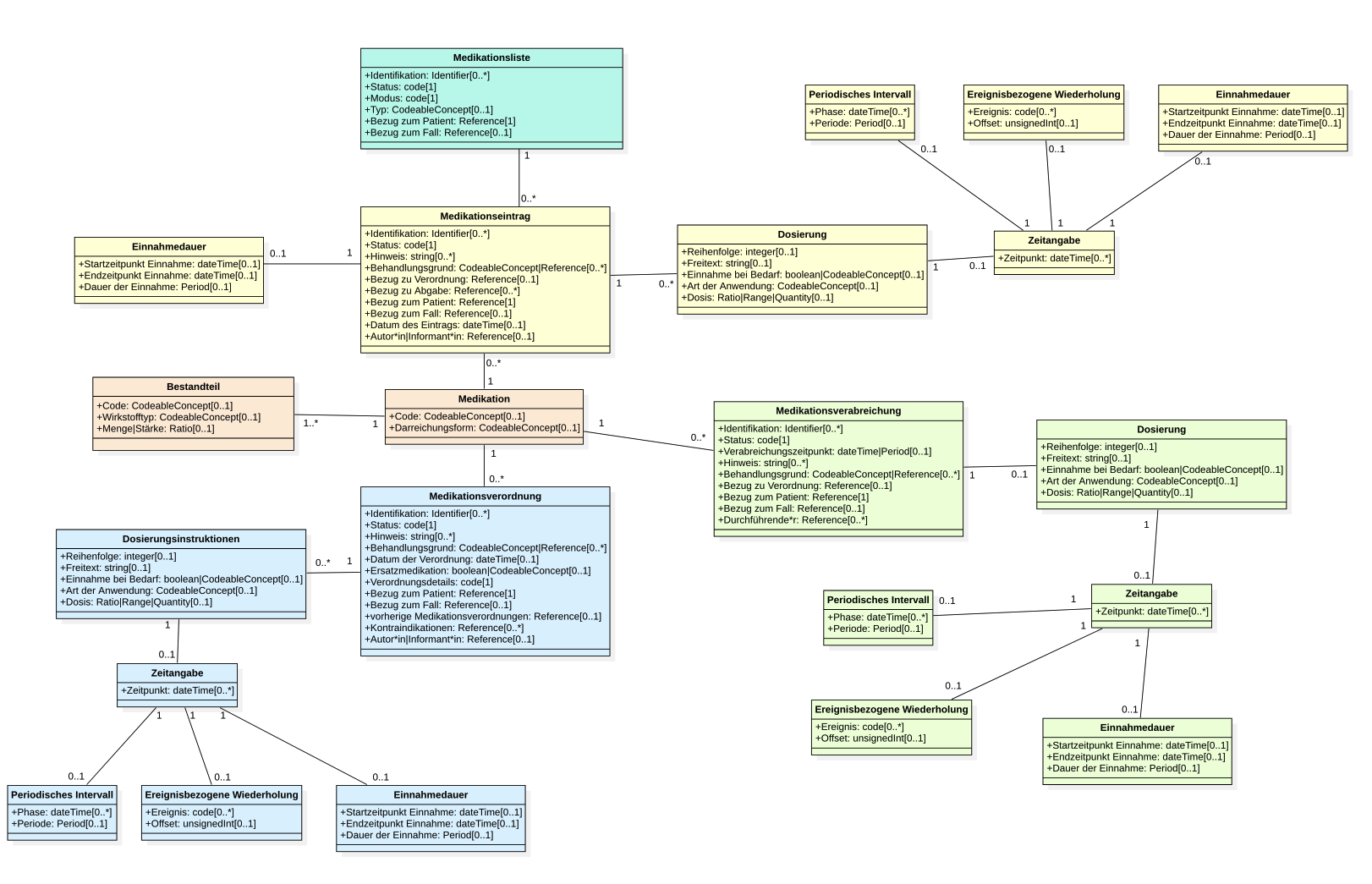
Im oberen Teil des Implementationsguide werden zur Beschreibung der Module logische Informationsmodelle verwendet, um die Anwendungssicht darzustellen. Diese Modelle werden mit dem Werkzeug ART-DECOR entwickelt und können unter https://art-decor.org/art-decor/decor-datasets--mide-
zusammenhängend eingesehen werden.
|
|
web
|
github.com
|
Anmerkungen und Kritik werden in Form von Issues im GitHub-Repository
stets gern entgegengenommen.
|
|
web
|
creativecommons.org
|
Dieses Werk ist lizenziert unter der Creative Commons Namensnennung 4.0 International Lizenz (CC BY 4.0)
.
|
|
web
|
art-decor.org
|
Die offizielle und abgenommene Version des Informationsmodells für das Modul Medikation findet sich auf ART-DECOR
. Zur Vereinheitlichung der Repräsentation wurde das Informationsmodell zusätzlich als FHIR Logical Model abgebildet: MII LM Medikation
.
|
|
web
|
github.com
|
Die folgenden CRMI-Metadaten werden in
sushi-config.yaml
gesetzt und landen in der erzeugten ImplementationGuide
-Ressource.
|
|
web
|
github.com
|
[TODO: Aktivieren Sie die für Ihr Modul nötigen Blöcke und ziehen Sie die
Tabellen oben nach. Wenn Ihr Modul die CRMI-Shareable-/Publishable-Profile
zusätzlich auf seine eigenen StructureDefinitions, CapabilityStatements,
CodeSysteme und ValueSets anwendet — das Idiom aus kerndatensatz-basis
ist
ein gemeinsames RuleSet
in
input/fsh/rulesets/crmi.fsh
—, ergänzen Sie die
entsprechenden Zeilen.]
|
|
web
|
github.com
|
Veröffentlicht ein Modul CodeSystem-Supplements, ist zu beachten: Das
CRMI-Profil ShareableCodeSystem
verlangt CodeSystem.caseSensitive
, während
die FHIR-Validierung warnt, dass ein Supplement caseSensitive
nicht erneut
angeben sollte, weil das dem ergänzten CodeSystem widersprechen könnte.
kerndatensatz-basis
beansprucht deshalb bei Supplements nur das Publishable
-CRMI-Profil und lässt
das Shareable-Profil weg.
|
|
web
|
www.go-fair.org
|
Die FAIR-Prinzipien
beschreiben
Ziele dafür, digitale Objekte auffindbar (Findable), zugänglich (Accessible),
interoperabel (Interoperable) und wiederverwendbar (Reusable) zu machen. Dieser
Abschnitt ist eine informative Selbsteinschätzung, wie die CRMI-Metadaten dieses
Leitfadens eine FAIR-konforme Veröffentlichung von FHIR-Spezifikationsartefakten
unterstützen.
|
|
web
|
ig.fhir.de
|
Die Arbeiten der Kerndatensatzspezifikationen basieren, wo möglich, auf internationalen Standards und Terminologien. Insbesondere sei hier die International Patient Summary
hervorgehoben. Eine Anpassung an die Gegebenheiten des deutschen Gesundheitswesens erfolgt durch die Verwendung der Deutschen Basisprofile
von HL7 Deutschland. Außerdem wird Kompatibilität zu den FHIR-Spezifikationen der Kassenärztlichen Bundesvereinigung (KBV)
und der gematik
angestrebt.
|
|
web
|
github.com
|
Die KDS-weiten Konformitätsregeln — Anforderungssprache nach RFC-2119, Must Support und der Umgang mit fehlenden Daten — werden zentral vom Meta-Modul
gepflegt und hier nicht wiederholt.
|
|
web
|
www.medizininformatik-initiative.de
|
Das
übergreifende Datenschutzkonzept der Medizininformatik-Initiative
regelt, wie Patientendaten über das Netz der Datenintegrationszentren hinweg
für die Forschung verarbeitet werden
dürfen: die Rechtsgrundlage (der Broad Consent der MII), die Rollen der
Datenintegrationszentren und der Use-&-Access-Committees sowie die
standortübergreifenden Anwendungsszenarien (Machbarkeitsanfragen, verteilte
Analysen, Daten- und Bioproben-Bereitstellung). Alles, was dieses Modul
spezifiziert, bewegt sich innerhalb dieses Rahmens — dieser Leitfaden fügt
keinen eigenen Verarbeitungszweck hinzu.
|
|
web
|
medizininformatik-initiative.github.io
|
Wie Daten, die ein Datenintegrationszentrum verlassen, praktisch
de-identifiziert werden, spezifiziert
DIMP (De-Identification — Minimisation — Pseudonymisation)
in der Dokumentation des Datenportals: direkte Identifikatoren werden
entfernt, vom genehmigten Projekt nicht benötigte Datenelemente entfallen, und
identifizierende Werte werden durch projektspezifische Pseudonyme ersetzt
(FHIR-Pseudonymizer-Konfiguration). Die Profile dieses Moduls beschreiben die
Daten vor
Anwendung von DIMP; welche Elemente eine konkrete
Datenbereitstellung erreicht, entscheidet je Projekt die DIMP-Konfiguration,
nicht dieser Leitfaden.
|
|
web
|
github.com
|
Übersetzte Seiten liegen unter input/translations/de/pagecontent/
(gleicher
Dateiname wie die englische Seite); Ressourcen-Übersetzungen als .po
-Dateien
unter input/translations/de/
. Details:
docs/recipes/add-translation.md
in diesem Repository.
|
|
web
|
github.com
|
Releases folgen dem
Module Release Workflow
:
Die Version wird im Release-Branch angehoben, der Changelog-Eintrag geschrieben,
die Validierungs-Workflows laufen auf dem Release-Pull-Request, und nach dem
Merge wird das Release getaggt.
|
|
web
|
www.netzwerk-universitaetsmedizin.de
|

|
|
web
|
github.com
|
Conformance
|
|
web
|
github.com
|
Conformance
|
|
web
|
github.com
|
General Requirements
|
|
web
|
github.com
|
Must Support
|
|
web
|
github.com
|
Handling Missing Data
|
|
web
|
www.netzwerk-universitaetsmedizin.de
|
IG © 2019+ NUM-DIZ
.
Package de.medizininformatikinitiative.kerndatensatz.medikation#2027.0.0-ballot based on FHIR 4.0.1
.
Generated 2026-09-11
Links: Table of Contents |
QA Report
| netzwerk-universitaetsmedizin.de
| medizininformatik-initiative.de
| Legal notice
HL7®, FHIR® and the FHIR flame design are registered trademarks of Health Level Seven International. Their use does not constitute endorsement by HL7.
|
|
web
|
www.netzwerk-universitaetsmedizin.de
|
Links: Table of Contents
|
QA Report
| netzwerk-universitaetsmedizin.de
| medizininformatik-initiative.de
| Legal notice
HL7®, FHIR® and the FHIR flame design are registered trademarks of Health Level Seven International. Their use does not constitute endorsement by HL7.
|
|
web
|
www.medizininformatik-initiative.de
|
Links: Table of Contents
|
QA Report
| netzwerk-universitaetsmedizin.de
| medizininformatik-initiative.de
| Legal notice
HL7®, FHIR® and the FHIR flame design are registered trademarks of Health Level Seven International. Their use does not constitute endorsement by HL7.
|
|
web
|
www.netzwerk-universitaetsmedizin.de
|
Links: Table of Contents
|
QA Report
| netzwerk-universitaetsmedizin.de
| medizininformatik-initiative.de
| Legal notice
HL7®, FHIR® and the FHIR flame design are registered trademarks of Health Level Seven International. Their use does not constitute endorsement by HL7.
|
|
web
|
github.com
|
Where the versions come from.
Every package in the table is pinned
directly in
sushi-config.yaml
( dependencies:
) — including hl7.terminology.r4
(THO) and
hl7.fhir.uv.extensions.r4
, and those two deliberately so: the IG
Publisher's
automatic-packages rule
consults only this guide's own
dependency list, so without a direct pin
every build would silently inject the latest THO/extensions release — a
version pinned by the MII meta package alone cannot control the build
(verified in the publisher source at the pinned release). A weekly check
warns when these two pins drift from what the pinned meta package ships,
and the exact versions a concrete build used are recorded in its
qa-versions.json
output.
|
|
web
|
github.com
|
Expansion parameters are query parameters that can be passed to a ValueSet
$expand
operation to control how the ValueSet is expanded — that is, how the
full list of codes is generated from the ValueSet definition. The
IG Parameters
used for this IG are declared in
sushi-config.yaml
( parameters:
). A module that pins its expansion parameters through a CRMI
manifest additionally links the generated Parameters
resource from here (see
the commented manifest blocks in sushi-config.yaml
and the Metadata Overview
page, if the module keeps it).
|
|
web
|
ig.fhir.de
|
Dosage information should follow the Dosage profile from the Medication IG DE
. Further guidance on documenting dosages is available in the Medication IG DE (STU1)
.
|
|
web
|
ig.fhir.de
|
Dosage information should follow the Dosage profile from the Medication IG DE
. Further guidance on documenting dosages is available in the Medication IG DE (STU1)
.
|
|
web
|
github.com
|
This module declares no SearchParameter resources of its own
. Which search parameters MUST be supported follows from the CapabilityStatement rendered above; the definitions come from the FHIR base specification and from the MII-wide search parameter list of the Meta module
. The MII-wide rules are maintained there centrally and are not repeated here.
|
|
web
|
ig.fhir.de
|
Added
: dependency on de.fhir.medication
added, version STU1
.
|
|
web
|
ig.fhir.de
|
Added
: MedicationStatement.dosage
and MedicationRequest.dosageInstruction
use the Dosage profile
from de.fhir.medication
for dosage information.
|
|
web
|
ig.fhir.de
|
Fixed
: dosage information in the example instances conforms to de.fhir.medication
STU1
.
|
|
web
|
github.com
|
Added
: (MedicationAdministration|MedicationStatement|MedicationRequest).medicationCodeableConcept
carries a reference to UNII (see PR #106
).
|
|
web
|
www.ontoserver.mii-termserv.de
|
Added
: new value sets and bindings for ATC ( .../ValueSet/mii-vs-medikation-atc
), ASK ( .../ValueSet/mii-vs-medikation-ask
) and UNII ( .../ValueSet/mii-vs-medikation-unii
), which can be expanded with the MII terminology server
and thus allow extended validation.
|
|
web
|
www.ontoserver.mii-termserv.de
|
CodeSystem resources for external terminologies (ATC, ASK, EDQM and so on) are no longer published in this module. They are to be obtained from the Service Unit Terminological Services (SU-TermServ): https://www.ontoserver.mii-termserv.de/
|
|
web
|
www.ema.europa.eu
|
Wherever possible, terminologies and unique codes conforming to international standards are to be used. For medicinal product and dosage information these are the ISO standards for the Identification of Medicinal Products (IDMP)
, which are implemented above all in the regulatory context.
|
|
web
|
en.wikipedia.org
|
The Unique Ingredient Identifier (UNII)
of the US Substance Registration System. It is not available in Germany.
|
|
web
|
www.cas.org
|
The CAS Registry Number
from the Chemical Abstracts Service database.
|
|
web
|
www.who.int
|
For naming substances, the registered substance names can be used; these are usually — but not always — the WHO INNs (International Non-proprietary Names)
. Within the MII the German spelling should be used, which in some cases differs slightly from the English version.
|
|
web
|
www.whocc.no
|
It is recommended to use ATC codes (Anatomical Therapeutic Chemical classification)
for coding active ingredients only with reservations, since an ATC code cannot be assigned unambiguously to a substance.
|
|
web
|
gitlab.com
|
Publisher and licence:
the publisher of this content is Informationsstelle für Arzneispezialitäten – IFA GmbH / Vidal MMI Germany GmbH
, not the MII. A usage agreement with the TMF covers the Vidal MMI raw data; use is therefore permitted only within the projects of the Medical Informatics Initiative and the Network University Medicine
. This content is consequently not
covered by the CC-BY-4.0 licence of the rest of the module. Publisher and licence statement are taken verbatim from the PZN distribution of the Service Unit Terminological Services
.
|
|
web
|
de.wikipedia.org
|
the Pharmazentralnummer (PZN)
. These numbers must be made queryable via a publicly available URL/URI (§ 31b SGB V).
|
|
web
|
standardterms.edqm.eu
|
the standard terminologies of the EDQM (European Directorate for the Quality of Medicines and Health Care)
, "Routes and Methods of Administration" and "Pharmaceutical Dose Forms".
|
|
web
|
applications.kbv.de
|
alternatively the dose form may be given as an IFA code, per the KBV medication plan specification. Key table: https://applications.kbv.de/S_BMP_DARREICHUNGSFORM_V1.02.xhtml
|
|
web
|
www.bfarm.de
|
ATC Anatomical Therapeutic Chemical classification
|
|
web
|
www.medizininformatik-initiative.de
|
Medication data are central to a wide range of research questions, for example in pharmacovigilance (drug therapy safety) or as inclusion and exclusion criteria for study cohorts. They appear in the audit queries compiled by the Data Sharing Working Group
, for instance in the proposals of the SMITH consortium
. The MEDICATION module is also required for the cross-consortium use case POLAR — polypharmacy.
|
|
web
|
www.kbv.de
|
When creating the dataset for documenting medication, specifications were taken into account that were produced for the KBV patient-related medication plan V2.6
and Medikationsplan PLUS
, and for the International Patient Summary
.
|
|
web
|
international-patient-summary.net
|
When creating the dataset for documenting medication, specifications were taken into account that were produced for the KBV patient-related medication plan V2.6
and Medikationsplan PLUS
, and for the International Patient Summary
.
|
|
web
|
www.ema.europa.eu
|
For medication terminologies (medicinal products, substances and so on) the ISO standards for the Identification of Medicinal Products (IDMP)
are to be taken into account.
|
|
web
|
ig.fhir.de
|
The module builds on the Medication DE implementation guide
of HL7 Germany, pinned to
de.fhir.medication 1.0.7
(STU1). It provides the DosageDE
profile, to which MedicationStatement.dosage
and MedicationRequest.dosageInstruction
are typed — dosage information therefore follows a structure agreed across Germany rather than one specific to this module.
|
|
web
|
github.com
|
The module deliberately stays on 1.0.7 while 2.0.0 is in ballot. Adopting it concerns the dosage specifications in particular and is tracked in issue #107
.
|
|
web
|
github.com
|
Conformance
— the KDS-wide conformance rules (requirements language, Must Support, handling missing data) are maintained centrally by the
Meta module
;
the module-specific Security and Privacy
considerations are part of this guide.
|
|
web
|
ig.fhir.de
|
This module is part of the MII Core Dataset. It relates in particular to the modules Person
, Fall
, Prozedur
and Diagnose
— see Guidance for Implementers
. Its formal dependencies are the German base profiles, the MII meta module, the IHE Germany terminology, the International Patient Summary and the Medication IG DE
; the full list is in sushi-config.yaml
and on the ImplementationGuide page
.
|
|
web
|
github.com
|
More FHIR implementation guides can be found in the official
FHIR IG Registry
(source:
FHIR/ig-registry
).
|
|
web
|
github.com
|
Questions about this publication can be asked on the HL7 FHIR Zulip chat.fhir.org
in the german/mi-initiative
stream. Comments and issues are welcome as Issues
on GitHub
.
|
|
web
|
creativecommons.org
|
This work is licensed under the Creative Commons Attribution 4.0 International License (CC BY 4.0)
.
|
|
web
|
art-decor.org
|
The official, approved version of the information model for the Medikation module is available on ART-DECOR
. To harmonise the representation, the information model was additionally expressed as a FHIR logical model: MII LM Medikation
.
|
|
web
|
github.com
|
The following CRMI-related metadata is set in
sushi-config.yaml
and ends up in the generated ImplementationGuide
resource.
|
|
web
|
github.com
|
[TODO: Enable the blocks your module needs and then update the tables above.
If your module also applies the CRMI shareable/publishable profiles to its own
StructureDefinitions, CapabilityStatements, CodeSystems and ValueSets — the
kerndatensatz-basis
idiom is a shared RuleSet
in
input/fsh/rulesets/crmi.fsh
— add the corresponding rows here.]
|
|
web
|
github.com
|
Where a module publishes CodeSystem supplements, note that the CRMI
ShareableCodeSystem
profile requires CodeSystem.caseSensitive
, while FHIR
validation warns that a supplement should not restate caseSensitive
because
that could contradict the supplemented code system.
kerndatensatz-basis
therefore claims only the publishable
CRMI profile on supplements and omits
the shareable one.
|
|
web
|
www.go-fair.org
|
The FAIR principles
describe goals
for making digital objects Findable, Accessible, Interoperable and Reusable.
This section is an informative self-assessment of how the CRMI-based metadata of
this guide supports FAIR-aligned publication of FHIR specification artifacts.
|
|
web
|
ig.fhir.de
|
The core dataset specifications are based, wherever possible, on international standards and terminologies — notably the International Patient Summary
. Adaptation to the conditions of the German healthcare system is achieved by using the German base profiles
of HL7 Germany. Compatibility with the FHIR specifications of the National Association of Statutory Health Insurance Physicians (KBV)
and of gematik
is also sought.
|
|
web
|
github.com
|
The KDS-wide conformance rules — requirements language per RFC-2119, Must Support and the handling of missing data — are maintained centrally by the Meta module
and are not repeated here.
|
|
web
|
www.medizininformatik-initiative.de
|
The
overarching data protection concept of the Medical Informatics Initiative
governs how patient data may be processed for research across the network of
Data Integration Centers: it
covers the legal basis (the MII Broad Consent), the roles of the Data
Integration Centers and Use & Access Committees, and the cross-site application
scenarios (feasibility queries, distributed analyses, data and biosample
provision). Everything this module specifies operates inside that framework —
this guide adds no processing purpose of its own.
|
|
web
|
medizininformatik-initiative.github.io
|
How data leaving a Data Integration Center is de-identified in practice is
specified by
DIMP (De-Identification — Minimisation — Pseudonymisation)
in the data portal documentation: direct identifiers are removed,
data elements not needed by the approved project are dropped, and identifying
values are replaced by project-specific pseudonyms (FHIR Pseudonymizer
configuration). The profiles of this module describe data before
DIMP is
applied; which elements survive a concrete data release is decided per project
by the DIMP configuration, not by this guide.
|
|
web
|
github.com
|
Translated pages live under input/translations/de/pagecontent/
(same file name
as the English page); resource translations are .po
files under
input/translations/de/
. Details:
docs/recipes/add-translation.md
in this repository.
|
|
web
|
github.com
|
Releases follow the
Module Release Workflow
:
the version is raised in the release branch, the changelog entry is written, the
validation workflows run on the release pull request, and the release is tagged
after the merge.
|