
MII IG Kerndatensatz-Modul Onkologie
2027.0.0-ballot.1 -
Germany
MII IG Kerndatensatz-Modul Onkologie
2027.0.0-ballot.1 -
Germany
This page is part of the MII IG Kerndatensatz-Modul Onkologie (v2027.0.0-ballot.1: Release) based on FHIR (HL7® FHIR® Standard) R4. This is the current published version. For a full list of available versions, see the Directory of published versions
This implementation guide describes a FHIR implementation of the oBDS. A pure 1:1 mapping of the complete dataset is neither substantively nor technically sensible. The most important deviations:
The CDS module Oncology contains those oBDS groups that primarily cover clinical-diagnostic and therapeutic data points. Several groups were therefore not implemented in FHIR:
The organ-specific modules were not part of the first profiling but have been part of the Oncology module since version 2026: prostate, breast, melanoma and colon.
The oBDS was optimized mainly for data reporting to the cancer registries. In the first versions the cardinalities were largely adopted from the oBDS, but are in places set "softer" to gain access to a broader data basis in a first step.
To ensure evaluability via the German Portal for Medical Research Data (FDPG), medication in systemic therapy requires ATC coding. Free text remains possible as an additional statement.
The oBDS XML schema provides a number of validations checking data quality and completeness. These are not technically implemented here. It can be assumed that oBDS data are validated in the primary tumor-documentation systems at least to the point that an export to XML is possible. Further validations (e.g. mutually exclusive data fields) could be added if the module is to serve as a data-collection basis for primary systems beyond its current purpose.
In the oBDS the data fields are bound to the reporting structure; groups with different cardinalities are often stored separately. Important changes, excerpt:
The GOLD project was initiated by Vision-Zero e. V. and aims at representing a complete oncological patient journey. The data model and profiles were derived from existing data models from care, research and industry. The first FHIR profiles focusing on diagnosis and classifications have flowed into several other projects, e.g. HL7 Germany's oncology base profiles and the MII imaging module. Current version: vision-zero-oncology.github.io/GOLD
The oncology base profiles delivered profiling groundwork (mainly in 2022) for a unified use of FHIR resources in the oncology sector. Work has been dormant since the 2022 comment phase; the base profiles now refer to this MII CDS module Oncology.
The DKTK's internal data model uses oBDS data prepared from tumor documentation systems in FHIR format as an exchange medium (simplifier.net/oncology). The original information model of the CDS module Oncology was strongly oriented towards the DKTK model. The profiling differs in that the DKTK profiles are self-contained, whereas an MII module should work as well as possible with the MII base modules (especially diagnosis, procedure, medication) and existing CDS modules. One of the main modeling decisions was therefore the use of the MII diagnosis and MII medication, and the representation of surgeries, radiotherapy and systemic/watchful-waiting therapies as MII procedures.
The model project on genome sequencing provides for the collection of a data set for next-generation sequencing (NGS) of oncology patients: diagnostic and therapeutic history, molecular-genetic description of the tumor, recommendations on study participation and systemic therapies, and follow-up information. A similar data set for rare diseases will be represented in the Rare Diseases module in the future.
The logical model of the data set is available as Logical Model mii-lm-mvgenomseq-onkologie; the mapping of its data elements to the MII CDS is provided as ConceptMap mii-cm-onkologie-to-mvgenomseq (work in progress).
The French common data model "Interoperability and data sharing of clinical and biological data in oncology" (OSIRIS) comprises two independent core datasets: a clinical and a genomic part; a third part on imaging and radiotherapy is in progress. The OSIRIS dataset models the temporal representation mainly around so-called "tumor events" (initial diagnoses or follow-up observations). Further information: PMC8140800; English version of the dataset on GitHub.
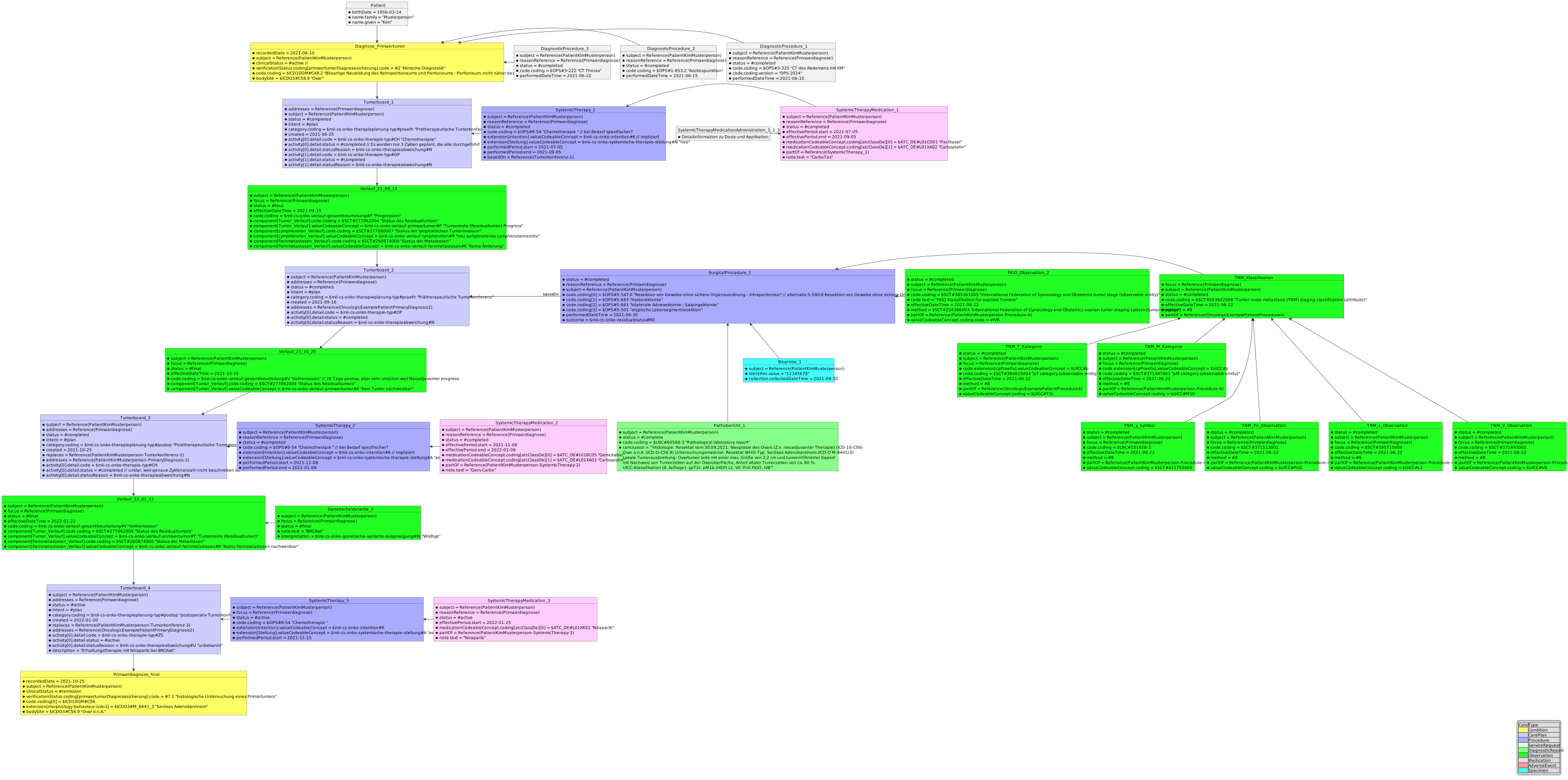
The oBDS is the basis for cancer registry reporting to the federal state registries. This profiling aims to make the data arising in cancer registration usable for other research fields. The FHIR representation of the example below makes clear that information on imaging, detailed treatment and irradiation schemes and genetic variants exists in detailed form outside the cancer registry data.
Disclaimer: The treatment course corresponds to a possible guideline-conformant therapy; data and course are constructed for test purposes, similarities with actual disease courses are coincidental.