

MII IG PRO
2027.0.0-ballot.1 -
Germany
MII IG PRO
2027.0.0-ballot.1 -
Germany
This page is part of the MII Implementation Guide PRO (v2027.0.0-ballot.1: 2027 Ballot 5) based on FHIR (HL7® FHIR® Standard) R4. This is the current published version. For a full list of available versions, see the Directory of published versions
Cross-instrument mapping enables the translation of scores between different PRO instruments that measure the same construct. This is essential for harmonizing data from different sources and ensuring comparability of study results.
Related pages:
The most common method is based on the assumption that persons with the same percentile rank on different instruments exhibit the same level of the measured construct.
Item Response Theory enables the placement of different instruments on a common metric through co-calibration. Details on IRT methodology see Domain-Based Scoring.
Linear or non-linear regression models for predicting scores of one instrument based on another.
The following figure shows validated mappings between PROMIS Depression T-Scores and eight other established depression scales:
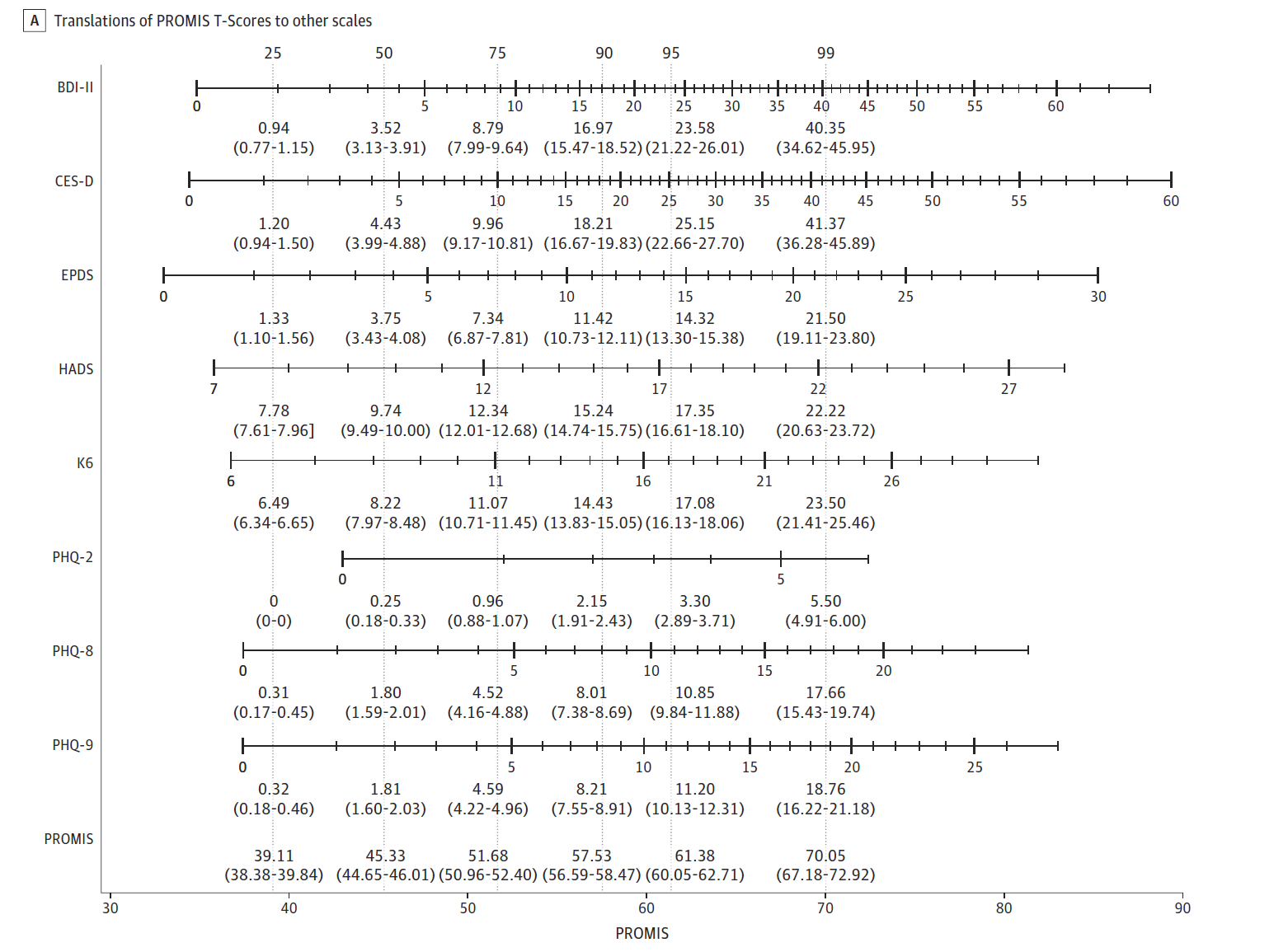
Figure 1: Translations of PROMIS T-Scores to other scales – Comprehensive mapping table for the depression domain
The table shows for each PROMIS T-Score (horizontal axis, 30-90):
Example reading:
A multi-center study uses different instruments:
Solution: All scores are mapped to PROMIS T-Scores for unified analysis.
A patient was initially assessed with BDI-II (Score: 25), follow-up with PHQ-9:
Systematic reviews can compare effect sizes across studies using different instruments through transformation to a common PROMIS metric.
Confidence intervals indicate the uncertainty of mappings. For critical clinical decisions, these intervals should be taken into account.
Mappings were developed and validated in specific populations. Generalizability to other populations (e.g., different cultures, age groups) should be verified.
Despite measuring the same construct, instruments may emphasize different aspects:
At the extremes of the scales, mapping accuracy may decrease, especially with:
// FSH
Instance: Depression-Score-Mapped
InstanceOf: Observation
* code = LOINC#77861-3 "PROMIS Depression T-score"
* valueQuantity = 60 '[T-score]'
* derivedFrom = Reference(PHQ9-Response)
* method = SCT#702663005 "Equipercentile equating"
* note.text = "Mapped from PHQ-9 raw score of 10 (95% CI: 7.55-8.91)"
For every mapping, document:
Cross-instrument mappings are a powerful tool for harmonizing PRO data. The depression domain exemplifies how various established instruments can be mapped onto a common PROMIS metric. Despite inherent limitations, these mappings enable better data integration, comparability, and continuous patient care across different settings.