

MII IG PRO
2027.0.0-ballot.1 -
Germany
MII IG PRO
2027.0.0-ballot.1 -
Germany
This page is part of the MII Implementation Guide PRO (v2027.0.0-ballot.1: 2027 Ballot 5) based on FHIR (HL7® FHIR® Standard) R4. This is the current published version. For a full list of available versions, see the Directory of published versions
The information model consists of four main components that interact to represent the complete lifecycle of Patient-Reported Outcomes:
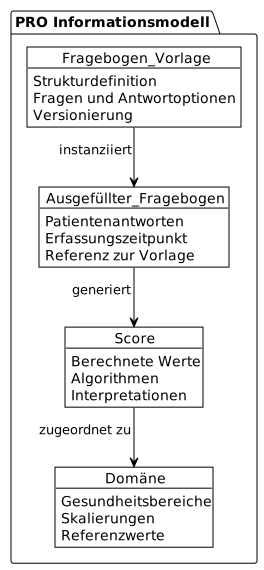
The complete information model can be viewed in the GitHub repository.
Legend
The UML diagrams use the following notation:
1 = exactly one0..1 = optional (zero or one)1..* = at least one0..* or * = any numberThe questionnaire template defines the structure and content of a PRO instrument. It contains all necessary information for the display, collection, and evaluation of questions.
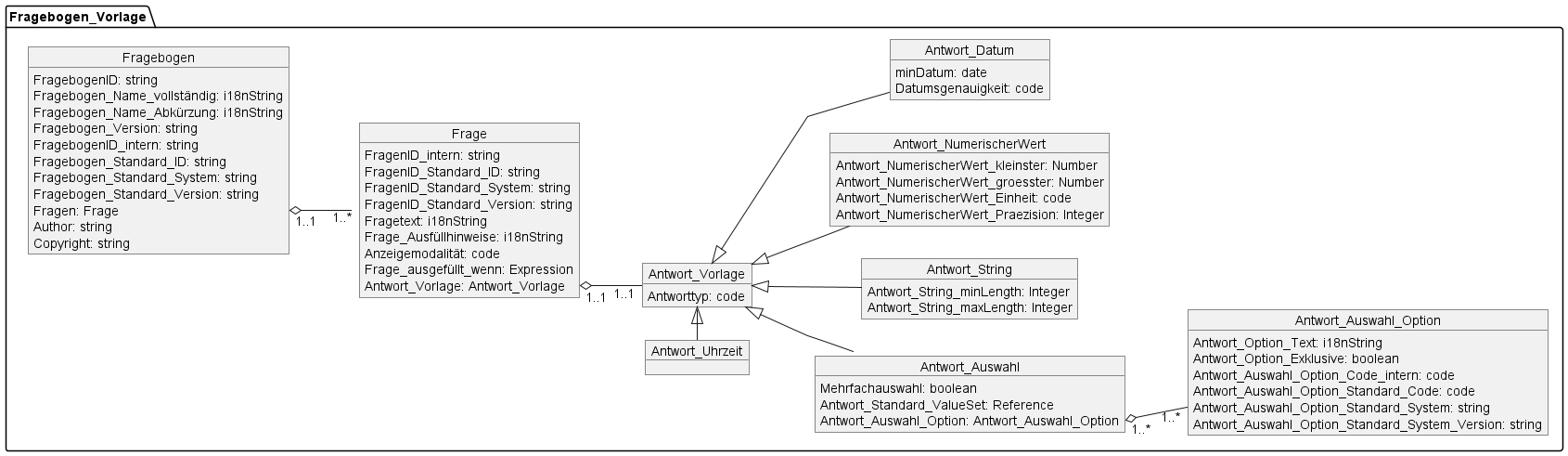
FHIR Mapping: The questionnaire template maps to the FHIR resource Questionnaire. The hierarchical structure of questions is represented through Questionnaire.item, while answer options are defined in answerOption.
The completed questionnaire captures the concrete answers of a patient at a specific point in time. It references the underlying questionnaire template and stores the given answers in a structured manner.
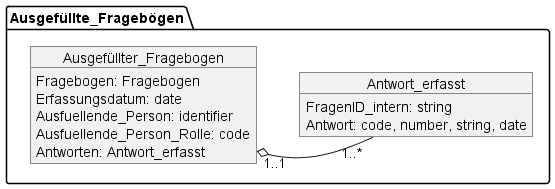
FHIR Mapping: The completed questionnaire maps to QuestionnaireResponse. The individual answers are stored in QuestionnaireResponse.item.answer, supporting various data types.
The score component encompasses both the definition of calculation algorithms (score template) and the concrete calculated values (score instance). It supports various calculation types and enables mappings between different scoring systems.
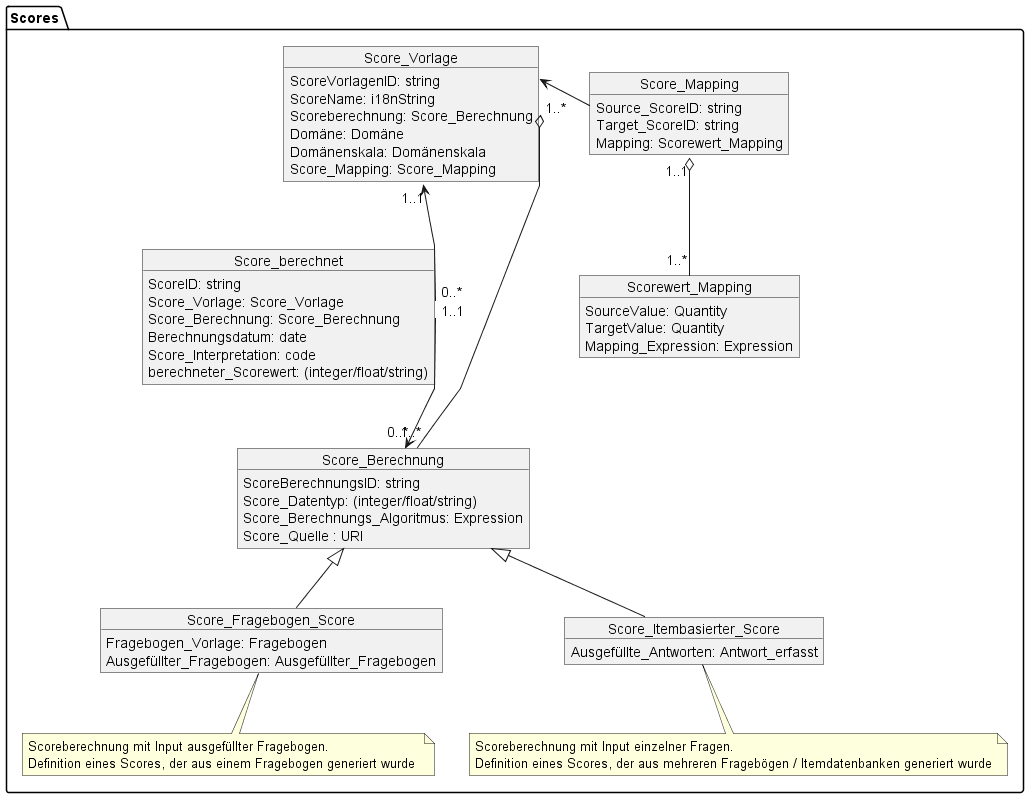
Distinction between Score Types:
FHIR Mapping:
ObservationDefinitionObservationObservation.derivedFromDomains classify PRO scores by health areas and enable their classification into overarching concepts. They define scaling and reference values for the interpretation of scores.
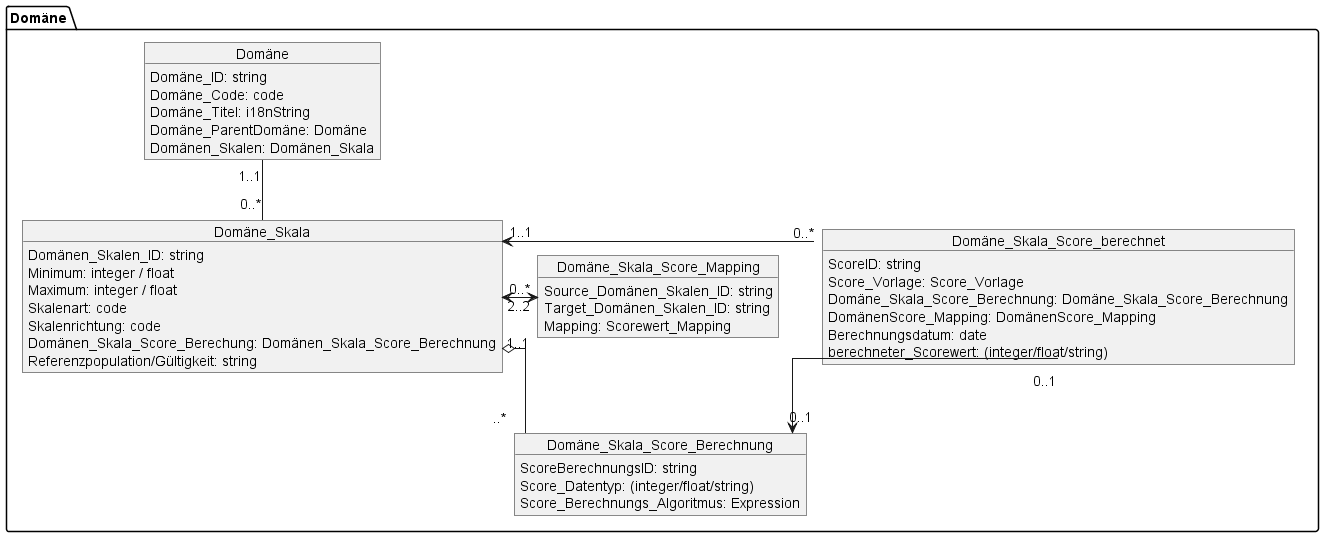
FHIR Mapping: Domains are primarily represented through terminology resources (CodeSystem, ValueSet) and metadata in the score definitions.
The UML diagrams show the conceptual structure of the information model. The concrete FHIR implementation differs in some details:
Details on the FHIR implementation can be found in the Technical Implementation section.
