

MII IG Symptom
2027.0.0-ballot -
Germany
MII IG Symptom
2027.0.0-ballot -
Germany
This page is part of the MII Implementation Guide Symptom (v2027.0.0-ballot: 2027 Ballot 1) based on FHIR (HL7® FHIR® Standard) R4. This is the current published version. For a full list of available versions, see the Directory of published versions
| Official URL: https://www.medizininformatik-initiative.de/fhir/modul-symptom/ImplementationGuide/mii-ig-symptom | Version: 2027.0.0-ballot | |||
| Active as of 2026-09-11 | Computable Name: MII_IG_Symptom | |||
This specification describes the FHIR representation of the core data set module "Symptom/clinical phenotype" of the Medical Informatics Initiative. The module's use cases and the corresponding FHIR profiles and terminology resources are described below in their binding form.
| Publication | |
|---|---|
| Date | 2026-08-31 |
| Version | 2027.0.0-ballot (CalVer YYYY.n.n) |
| Status | active |
| Realm | DE |
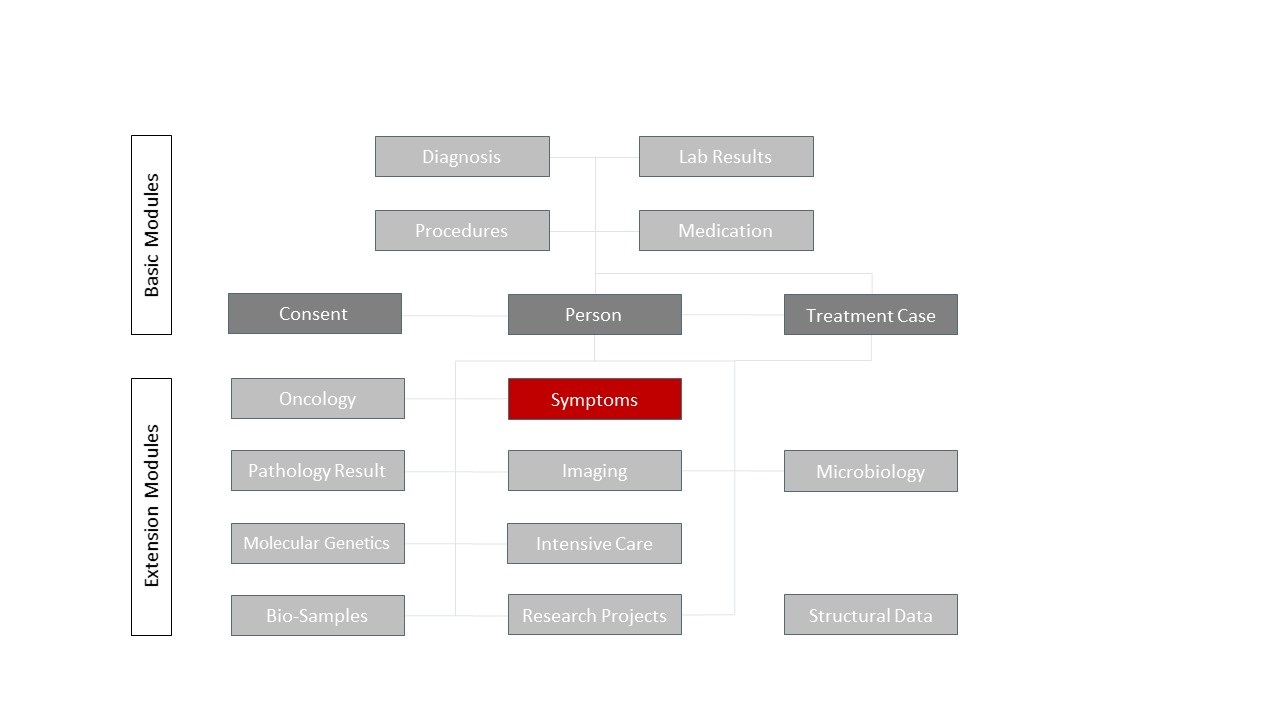
The extension module Symptoms/clinical state enables representations of clinical states and clinical observations as they appear in clinical documentation — either as symptoms, clinical problems, diseases and dispositions, or as findings, observations and measurements. These are represented in summary form as a state (Condition) or an observation (Observation). Connected representations built from observations and the interpretations derived from them are possible and can be assembled hierarchically into complex aggregates (clinical phenotypes). This module can be used whenever no specific representation exists in already available dedicated modules such as Diagnosis or Laboratory, or when those are not applicable for various reasons. Whether this extension module can and should be used must be examined in the context of each specific application. Within a Condition, no distinction is made between symptoms, diseases and dispositions, since that distinction is difficult and ambivalent and therefore of little relevance in clinical medicine. The distinction between a state (Condition) and an observation (Observation), however, is of practical importance. Put simply, Observations characteristically represent measurements or questionings via attribute–value or question–answer pairs. Reference is made here to the descriptions of the FHIR resources Condition and Observation, to which the following also refers.
(Disease) states can be clearly distinguished from the underlying observations: states are summarizing/assessing determinations (e.g. anemia) or anamnestic statements about underlying observations or measurements (hemoglobin content with a value/quantity).
This implementation guide is addressed to:
Data integration centers (DIC), software developers and system architects
implementing FHIR-based solutions.
→ see Profiles and Logical Models.
Scientists using core-data-set data for medical research.
→ see Guidance.
This module is part of the MII core data set; the other KDS modules and their dependencies are described at medizininformatik-initiative.de.
Formal dependencies of this module (see
dependenciesinsushi-config.yaml): the Meta module (2027.0.0-ballot), the German base profiles (1.6.0) and HL7 Europe Base (2.0.0). The subject-matter relationships to the Diagnosis, Laboratory and Person modules are described in the Guidance for Implementers.
Further FHIR implementation guides can be found in the official
FHIR IG Registry (source:
FHIR/ig-registry).
This guide was created within the Medical Informatics Initiative and is subject, via its governance process, to the consultation procedure of the Interoperability Forum and the Technical Committees of HL7 Germany e. V.
Questions about this publication can be asked at
chat.fhir.org
in the german/mi-initiative stream.
Comments and criticism are always welcome as issues on GitHub.
Copyright © 2022+: TMF e. V., Charlottenstraße 42, 10117 Berlin
The content of this specification is public. Reuse and publication claims are not restricted. This work is licensed under the Creative Commons Attribution 4.0 International License (CC BY 4.0).
For the usage rights of the underlying FHIR technology, see the FHIR base specification.
Some of the code systems used are published and maintained by other organizations. The copyright of the publishers listed there applies.
The content of this document is public. Note that parts of this document are based on FHIR version R4, for which the copyright of HL7 International applies.