

MII IG Laborbefund
2027.0.0-ballot -
Germany
MII IG Laborbefund
2027.0.0-ballot -
Germany
MII IG Laborbefund - Local Development build (v2027.0.0-ballot) built by the FHIR (HL7® FHIR® Standard) Build Tools. See the Directory of published versions
| Official URL: https://www.medizininformatik-initiative.de/fhir/core/modul-labor/ImplementationGuide/mii-ig-labor | Version: 2027.0.0-ballot | |||
| Active as of 2026-09-14 | Computable Name: MII_IG_Labor | |||
This specification describes the FHIR representation of the Medical Informatics Initiative (MII) core data set module Laboratory Report. It defines the module's use cases, FHIR profiles and terminology resources in their normative form.
Laboratory tests play a decisive role in most medical diagnoses. Preliminary results can already be relevant in time-critical applications, such as clinical decision support warning about a low haemoglobin value. Final laboratory results are normally used in both patient care and research. The central document and subject of this module is the laboratory report produced by a medical laboratory.
For data management and integration in data integration centres, software developers and system architects building FHIR-based solutions.
For scientists working with MII data.
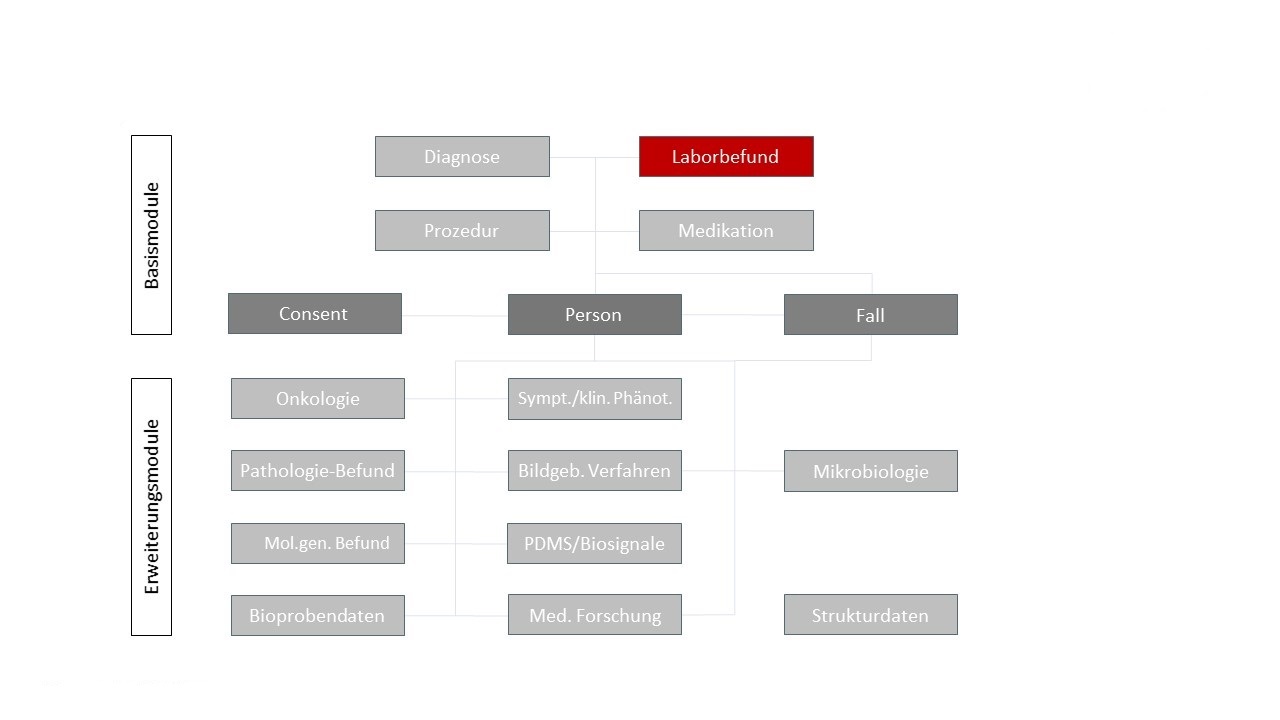
The Laboratory Report module in the MII core data set
The module covers:
The specimen is not profiled here. The module reuses the Biobank module's profile; the mapping is described under Specimen.
| Publication | |
|---|---|
| Date | not yet published |
| Version | 2027.0.0-ballot |
| Status | active |
| Realm | DE |
This guide was created within the Medical Informatics Initiative and is subject to the governance and ballot processes of the Interoperability Forum and the Technical Committees of HL7 Germany.
Questions on this publication may be asked at any time at https://chat.fhir.org in the stream 'german/mi-initiative'.
Comments and criticism are received as GitHub issues.
Copyright © 2019+: TMF e. V., Charlottenstraße 42, 10117 Berlin
The content of this specification is public. Claims to reuse or republication are not restricted.
On the terms of use of the underlying FHIR technology, see the FHIR base specification.
Some of the code systems used are issued and maintained by other organisations. The copyright of the publishers listed there applies.
The content of this document is public. Note that parts of this document are based on FHIR version R4, for which the copyright of HL7 International applies.