

MII IG PRO
2027.0.0-ballot.1 -
Germany
MII IG PRO
2027.0.0-ballot.1 -
Germany
This page is part of the MII Implementation Guide PRO (v2027.0.0-ballot.1: 2027 Ballot 5) based on FHIR (HL7® FHIR® Standard) R4. This is the current published version in its permanent home (it will always be available at this URL). For a full list of available versions, see the Directory of published versions
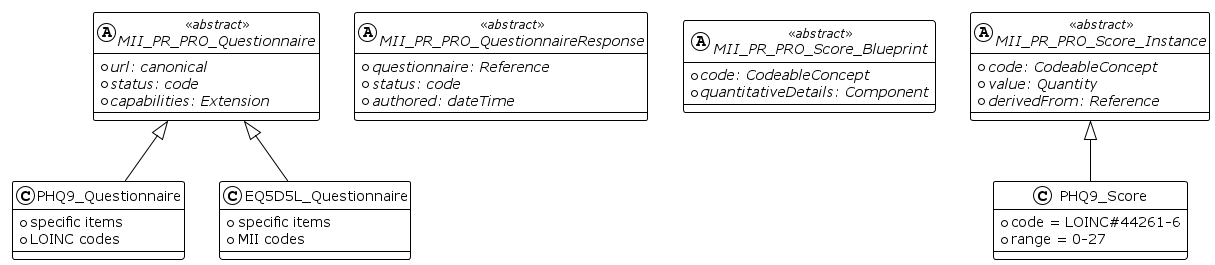
The MII PRO module defines abstract profiles that serve as the basis for all PRO implementations. These profiles are marked abstract = true and are not intended to be instantiated directly. They establish the common structures and behaviours that instrument-specific profiles must extend. The two profiles for Questionnaire and QuestionnaireResponse inherit from the SDC specification, while the two score profiles for Observation and ObservationDefinition inherit directly from the FHIR specification.
Abstract profiles ensure that common structures are used consistently across all implementations while preventing the creation of incomplete or generic instances. Every PRO instrument must define a concrete profile that inherits from these abstract profiles and adds the instrument-specific detail.
| Profile | Resource type | Base | Description |
|---|---|---|---|
| MII_PR_PRO_Questionnaire | Questionnaire | SDC Questionnaire | Basis for all PRO questionnaires |
| MII_PR_PRO_QuestionnaireResponse | QuestionnaireResponse | SDC QuestionnaireResponse | Structure of completed questionnaires |
| MII_PR_PRO_Score_Blueprint | ObservationDefinition | FHIR R4 | Templates for PRO score definitions |
| MII_PR_PRO_Score_Instance | Observation | FHIR R4 | Concrete score observations |
The abstract profiles form the basis of a clear inheritance hierarchy:
Because these profiles are marked abstract, the following rules apply:
Using abstract profiles offers several benefits for the MII PRO module:
Existing implementations already using these profiles need adjusting:
abstract = true