This page is part of the MII Implementation Guide PRO (v2027.0.0-ballot.1: 2027 Ballot 5) based on FHIR (HL7® FHIR® Standard) R4. This is the current published version in its permanent home (it will always be available at this URL). For a full list of available versions, see the Directory of published versions
Domains
Overview of Health Domains
Health domains are fundamental constructs that represent different aspects of health and well-being. In the context of Patient-Reported Outcomes (PROs), domains enable the systematic capture and comparability of health states across different measurement instruments.
Related pages:
Definition and Significance
A health domain is a specific, theoretically grounded aspect of health that can be captured by various measurement instruments. The domain-based structuring of PROs offers several advantages:
- Interoperability: Different questionnaires measuring the same construct become comparable
- Flexibility: Institutions can choose the instrument that best fits their needs
- Continuity: Comparability is maintained even when instruments are changed
- Norming: Uniform reference values across instruments
PROMIS Framework: The 8+1 Core Domains
The MII PRO Module follows the PROMIS (Patient-Reported Outcomes Measurement Information System) framework, which defines 8 scientifically validated core domains. These domains form the conceptual foundation for systematic PRO capture and have been operationalized in the PROMIS-29 Profile v2.1:
- Physical Function – 4 items
- Anxiety – 4 items
- Depression – 4 items
- Fatigue – 4 items
- Sleep Disturbance – 4 items
- Ability to Participate in Social Roles and Activities – 4 items
- Pain Interference – 4 items
- Pain Intensity – 1 item
Additional important PROMIS domain in the MII PRO Module:
- Cognitive Function – captured by the PROMIS Cognitive Function 4a Short Form
These 9 domains represent the most important aspects of self-reported health and have been validated through extensive psychometric research. The PROMIS-29 instrument (29 items) captures the first 8 domains, while Cognitive Function is supplemented by separate Short Forms.
Comparable multi-domain instruments:
- SF-36 (Short Form 36): 8 domains of health-related quality of life
- WHOQOL-BREF: WHO instrument with 4 main domains (physical, psychological, social, environment)
- EQ-5D: 5 dimensions (mobility, self-care, usual activities, pain, anxiety/depression)
Core Domains in the MII PRO Module
The implementation in the MII PRO Module follows the PROMIS structure and extends it with additional established instruments:
1. Depression Domain (PROMIS Core Domain)
Status: Fully implemented (2025)
LOINC Code: 77861-3 "PROMIS Depression T-score"
Supported instruments:
- PHQ-9 (Patient Health Questionnaire-9) – Details
- BDI-II (Beck Depression Inventory II) – Details
- PROMIS Depression Short Forms – Details
- HADS-D (Hospital Anxiety and Depression Scale - Depression)
- EPDS (Edinburgh Postnatal Depression Scale)
- CES-D (Center for Epidemiologic Studies Depression Scale)
Characteristics:
- Captures symptoms of depressive mood, dejection, hopelessness
- T-Score normalization (Mean=50, SD=10)
- Population norms based on EHIS Wave 3 (n=287,530)
- Validated cross-walking tables between instruments – see Mappings
2. Anxiety Domain (PROMIS Core Domain: Anxiety)
Status: Planned (2026)
Planned instruments:
- GAD-7 (Generalized Anxiety Disorder-7)
- PROMIS Anxiety
- HADS-A (Hospital Anxiety and Depression Scale - Anxiety)
- BAI (Beck Anxiety Inventory)
Characteristics:
- Captures worry, nervousness, tension, anxiousness
- Differentiation between state and trait anxiety
- Somatic vs. cognitive anxiety components
3. Physical Function (PROMIS Core Domain: Physical Function)
Status: Partially implemented (PROMIS-29, EQ-5D)
Implemented instruments:
- PROMIS Physical Function – Details
- EQ-5D Mobility Dimension – Details
- Planned: HAQ, WHODAS, SF-36 PF
Characteristics:
- Mobility, self-care, everyday activities
- Differentiation by severity of limitation
- Age- and sex-specific norms
- Item banking for adaptive measurement – see figure
4. Pain Domain (PROMIS Core Domains: Pain Interference and Pain Intensity)
Status: Partially implemented (PROMIS-29, EORTC)
Components:
- Pain Intensity: Numeric Rating Scale (0-10)
- Pain Interference: Impact of pain on functioning
- Pain Quality: Nature and characteristics of pain
Implemented instruments:
- PROMIS Pain Intensity
- PROMIS Pain Interference
- EORTC QLQ-C30 Pain Scale – Details
5. Fatigue (PROMIS Core Domain: Fatigue)
Status: Partially implemented (PROMIS-29, EORTC)
Instruments:
- PROMIS Fatigue
- EORTC QLQ-C30 Fatigue Scale
- Planned: FSS, FACIT-F
Characteristics:
- Physical and mental exhaustion
- Impact on daily activities
- Differentiation from depression
6. Sleep Disturbance (PROMIS Core Domain: Sleep Disturbance)
Status: Partially implemented (PROMIS-29)
Instruments:
- PROMIS Sleep Disturbance
- Planned: PSQI, ISI
Characteristics:
- Sleep quality, difficulty falling and staying asleep
- Daytime sleepiness as a consequence
- Circadian rhythm disturbances
7. Social Function (PROMIS Core Domain: Ability to Participate in Social Roles)
Status: Partially implemented (PROMIS-29, EORTC)
Instruments:
- PROMIS Ability to Participate in Social Roles
- EORTC QLQ-C30 Social Functioning
- Planned: SPS, F-SozU
Characteristics:
- Social participation and role function
- Quality of social relationships
- Isolation and loneliness
8. Cognitive Function (PROMIS Cognitive Function 4a)
Status: In implementation (2025)
Instruments:
- PROMIS Cognitive Function 4a Short Form
- EORTC QLQ-C30 Cognitive Functioning (already implemented)
Characteristics:
- Concentration and memory
- Cognitive clarity and mental acuity
- Subjective cognitive abilities
Specialized Domains
Oncology-Specific Domains: EORTC QLQ-C30 Framework
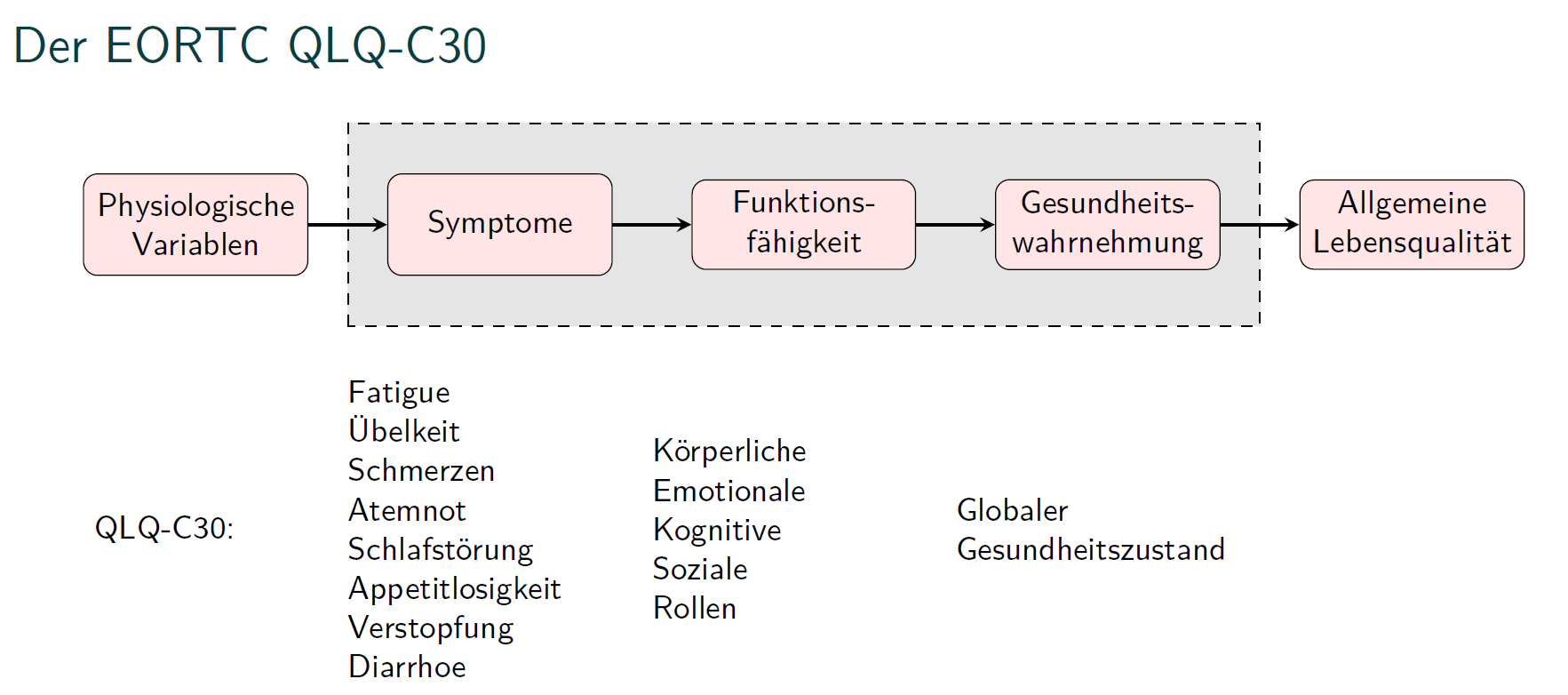
Figure 1: Conceptual model of the EORTC QLQ-C30 – From physiological variables to quality of life
The EORTC QLQ-C30 framework illustrates the relationship between different domain levels:
- Physiological variables influence symptoms
- Symptoms affect functioning
- Functioning shapes health perception
- All factors culminate in overall quality of life
Implemented through the EORTC QLQ-C30:
- Nausea and vomiting
- Appetite loss
- Dyspnoea (shortness of breath)
- Constipation
- Diarrhoea
- Financial difficulties due to illness
Details see EORTC QLQ-C30 in the PRO Library.
Quality of Life Domains
- Global Quality of Life (EORTC, EQ-5D VAS)
- Health-Related Quality of Life (EQ-5D Index)
- Role Function (EORTC)
- Emotional Function (EORTC)
Domain Hierarchy and Relationships
Health (overarching)
+-- Physical Health
|   +-- Physical Function
|   +-- Pain
|   +-- Fatigue
|   +-- Symptom Burden
+-- Mental Health
|   +-- Depression
|   +-- Anxiety
|   +-- Cognitive Function
|   +-- Emotional Well-Being
+-- Social Health
|   +-- Social Function
|   +-- Social Support
|   +-- Role Function
+-- Global Health
    +-- Quality of Life
    +-- General Health Status
Domain Alignment and Questionnaire Capabilities
The MII PRO Module defines the "domain-alignment" capability for each instrument:
* extension[questionnaire-capabilities].extension[domain-aligned].valueBoolean = true
This means that an instrument:
- Is unambiguously assigned to one or more domains
- Produces scores that can be mapped to domain T-Scores
- Is comparable with other instruments of the same domain
Details on the technical implementation see Questionnaire Capabilities.
Methodological Foundations
Item Response Theory (IRT)
Classical Test Theory (CTT)
- Traditional method, used by PHQ-9, BDI-II
- Sum scores with linear transformation
- Simpler to implement, less precise
Cross-Walking and Harmonization
Practical Application of Domains
Clinical Decision Support
Domain-based thresholds for:
- Screening: Identification of patients requiring treatment
- Monitoring: Progress tracking and therapy adjustment
- Outcome assessment: Treatment success and remission
Research and Care Quality
- Meta-analyses: Pooling of studies with different instruments
- Registry studies: Harmonized outcomes across sites
- Quality indicators: Fair comparisons despite different assessments
Personalized Medicine
- Precision medicine: Domain profiles for therapy selection
- Adaptive care pathways: Domain-based algorithms
- Patient-centered care: Focus on relevant domains
Implementation Notes
FHIR Resources per Domain
- ObservationDefinition: Defines domain score with reference ranges
- ConceptMap: Mapping from instrument scores to domain scores
- Observation: Instances of domain scores with provenance
- Library (CQL): Calculation logic for complex transformations
Best Practices
- Always document the source instrument (
derivedFrom)
- Specify the mapping method (
method)
- Consider confidence intervals
- Use population-specific norms
Future Developments
Short-Term (2025-2026)
- Complete implementation of all PROMIS-29 domains
- Cross-walking tables for PHQ-9 to PROMIS Depression
- Validation studies for the German population
Medium-Term (2026-2027)
- Item-based domain scores
- Computer Adaptive Testing (CAT) integration
- Extended domains (spirituality, resilience)
Long-Term (2027+)
- AI-based domain prediction
- Multimodal integration (PROs + biomarkers)
- Real-time domain monitoring
Summary
The domain-based structuring of PROs in the MII Module enables a future-proof, flexible, and interoperable capture of health states. By consistently mapping different instruments onto shared domains, the vision of harmonized, patient-centered care becomes a reality. The depression domain already demonstrates the practical feasibility of this concept today, while additional domains will follow successively.
Next steps: