

MII IG Kerndatensatz-Modul Molekulargenetischer Befundbericht
2027.0.0-ballot.1 -
Germany
MII IG Kerndatensatz-Modul Molekulargenetischer Befundbericht
2027.0.0-ballot.1 -
Germany
This page is part of the MII IG Kerndatensatz-Modul Molekulargenetischer Befundbericht (v2027.0.0-ballot.1: Release) based on FHIR (HL7® FHIR® Standard) R4. This is the current published version. For a full list of available versions, see the Directory of published versions
This page lists the FHIR profiles of the Molekulargenetischer Befundbericht module
(naming convention MII_PR_<Module>_<Name>, see the
docs/recipes/add-a-profile.md in this repository, and the MII naming
conventions). The module's extensions are listed on the
Extensions page.
Guidance on using the elements when reporting variants can be found in the Genomics Report profile from the HL7 Genomics Reporting Implementation Guide.
The following table shows the inheritance relationships of the profiles in this module:
| Profile name | Parent profile (STU3) | Description |
|---|---|---|
| MII_PR_MolGen_MolekulargenetischerBefundbericht | genomic-report | Main report for genetic analyses |
| MII_PR_MolGen_Variante | variant | Genetic variant |
| MII_PR_MolGen_Genotyp | genotype | Genotype information |
| MII_PR_MolGen_DiagnostischeImplikation | diagnostic-implication | Diagnostic significance |
| MII_PR_MolGen_TherapeutischeImplikation | therapeutic-implication | Therapeutic significance |
| MII_PR_MolGen_MolekulareKonsequenz | molecular-consequence | Molecular effect |
| MII_PR_MolGen_Medikationsempfehlung | medication-recommendation | Medication recommendation |
| MII_PR_MolGen_EmpfohleneFolgemassnahme | followup-recommendation | Recommended follow-up action |
| MII_PR_MolGen_GenomicStudy | genomic-study | Genomic study |
| MII_PR_MolGen_GenomicStudyAnalysis | genomic-study-analysis | Analysis within the genomic study |
| MII_PR_MolGen_MolekularerBiomarker | molecular-biomarker | Base profile for the biomarker profiles of this module |
| Profile name | Parent profile | Description |
|---|---|---|
| MII_PR_MolGen_Mikrosatelliteninstabilitaet | MII_PR_MolGen_MolekularerBiomarker | MSI status |
| MII_PR_MolGen_Mutationslast | MII_PR_MolGen_MolekularerBiomarker | Tumor mutational burden |
Both reach Clinical Genomics STU3 through MII_PR_MolGen_MolekularerBiomarker, not directly.
Twelve profiles carry a short canonical, four carry one prefixed with
mii-pr-molgen-:
| Scheme | Canonical ends in | Profiles |
|---|---|---|
| short | …/StructureDefinition/variante |
the twelve older profiles |
| prefixed | …/StructureDefinition/mii-pr-molgen-genomic-study |
GenomicStudy, GenomicStudyAnalysis, MolekulareKonsequenz, MolekularerBiomarker |
The four prefixed ones were added during the migration to Clinical Genomics STU3 and picked up the prefix from their ids. The two GenomicStudy profiles also kept their English names, where the rest of the module names profiles in German.
This is not going to be harmonised. All four canonicals shipped in version
2026.0.4, so they are established identity: anyone using that release has these URLs
in profile bindings, in meta.profile and in search queries. Renaming them would
break those references, and a ballot is the wrong moment — reviewers would be
checking content and fighting broken references at the same time. Whether a common
convention should apply across all MII core dataset modules is a question for the
TF-KDS, not for this module alone.
When writing a reference by hand, take the canonical from the profile's own page rather than deriving it from the profile name.
| Profile name | Parent resource (FHIR R4) | Description |
|---|---|---|
| MII_PR_MolGen_AnforderungGenetischerTest | ServiceRequest | Request for genetic testing |
| MII_PR_MolGen_Familienanamnese | FamilyMemberHistory | Family history |
| MII_PR_MolGen_PolygenerRisikoScore | RiskAssessment | Polygenic risk score |
The following diagram visualizes the relationships between the various FHIR profiles in the module:
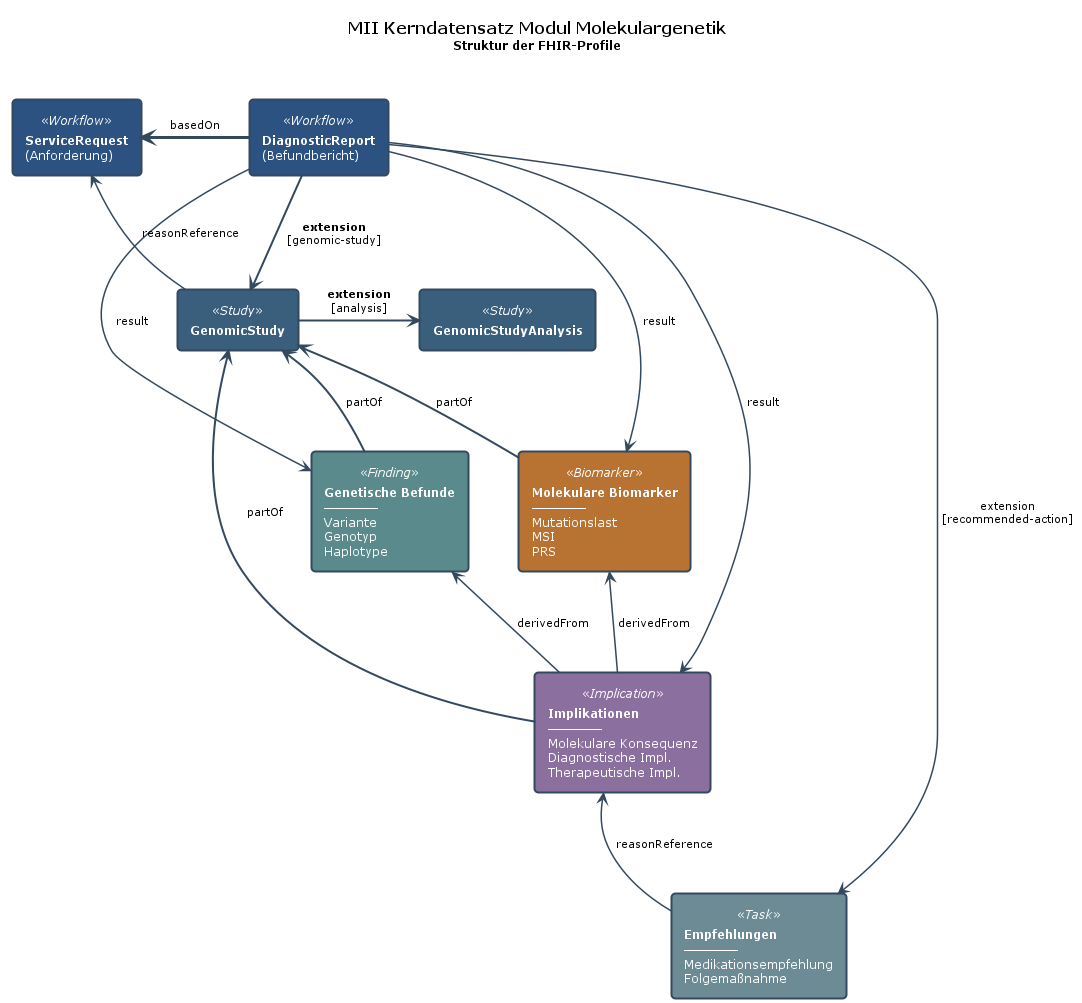
Legend:
The workflow for molecular genetic analyses covers the entire process, from requesting a genetic examination through to producing the final report.
ServiceRequest (request): initiates the diagnostic process with specific questions and the desired analyses.
DiagnosticReport (report): the central resource that brings together all results, interpretations and recommendations and presents them in a structured form.
basedOnresultrecommended-action extensionGenetic findings document the identified genetic variants and their molecular properties. These Observation-based profiles form the factual basis for molecular genetic diagnostics, without interpretive assessments.
Variant: a single genetic change with detailed molecular annotations.
Genotype: combination of alleles at a particular gene locus, important for inheritance analysis.
Haplotype: group of linked genetic variants that are inherited together.
Sequence Phase Relationship: describes the phase relationship between variants (cis/trans).
hasMember)partOfderivedFromNot contained in the findings:
Genetic implications assess and interpret the identified genetic findings with respect to their clinical significance. These Observation profiles contain the medical classification of the variants.
Diagnostic implication: assesses the significance of a variant for making the diagnosis and for the cause of the disease.
Therapeutic implication: describes the effects on therapy decisions and the choice of medication.
Molecular consequence: documents the functional effects on gene products (proteins, RNA).
derivedFromMolecular biomarkers are aggregated genomic or molecular measures that allow prognostic or predictive statements about the course of a disease and the response to therapy. All biomarker profiles inherit from the Clinical Genomics STU3 Molecular Biomarker profile.
Microsatellite instability (MSI): marker for DNA mismatch repair deficiency, important for immunotherapy decisions.
Mutational burden (TMB): total number of somatic mutations per megabase, a predictor of the response to checkpoint inhibitors.
Polygenic risk score (PRS): combined assessment of multiple genetic variants for risk stratification (based on RiskAssessment).
The Molecular Biomarker profile is flexibly extensible and is already being used for further analyses:
molecular-biomarker profilepartOfresultTherapy recommendations document the concrete courses of action that follow from the genetic findings. These Task-based profiles allow recommendations to be passed on in a structured form.
Medication recommendation: pharmacogenetically justified recommendations on the choice and dosing of medication.
Recommended follow-up action: further diagnostic or preventive measures based on the genetic findings.
reasonReferencerecommended-action extensionThe methodology profiles document the technical details of the genetic analyses performed, from sample processing through to the bioinformatic evaluation.
GenomicStudy: the overarching study that brings together all analyses for one sample (replaces UntersuchteRegion from STU2, plus more extensive methodology information and workflow IDs).
GenomicStudyAnalysis: individual analysis steps within a study (e.g. library prep, sequencing, bioinformatics).
UntersuchteRegion (old) → GenomicStudy (new)
partOfThe family history records genetically relevant diseases in blood relatives and is essential for interpreting hereditary variants and for risk assessment.
FamilyMemberHistory: documents diseases of family members with detailed information about the relationship.
Three dedicated extensions extend the standard resource:
For details see Extensions
patientreasonReferencereasonReference for the test indication