

MII IG Kerndatensatz-Modul Molekulargenetischer Befundbericht
2027.0.0-ballot.1 -
Germany
MII IG Kerndatensatz-Modul Molekulargenetischer Befundbericht
2027.0.0-ballot.1 -
Germany
This page is part of the MII IG Kerndatensatz-Modul Molekulargenetischer Befundbericht (v2027.0.0-ballot.1: Release) based on FHIR (HL7® FHIR® Standard) R4. This is the current published version. For a full list of available versions, see the Directory of published versions
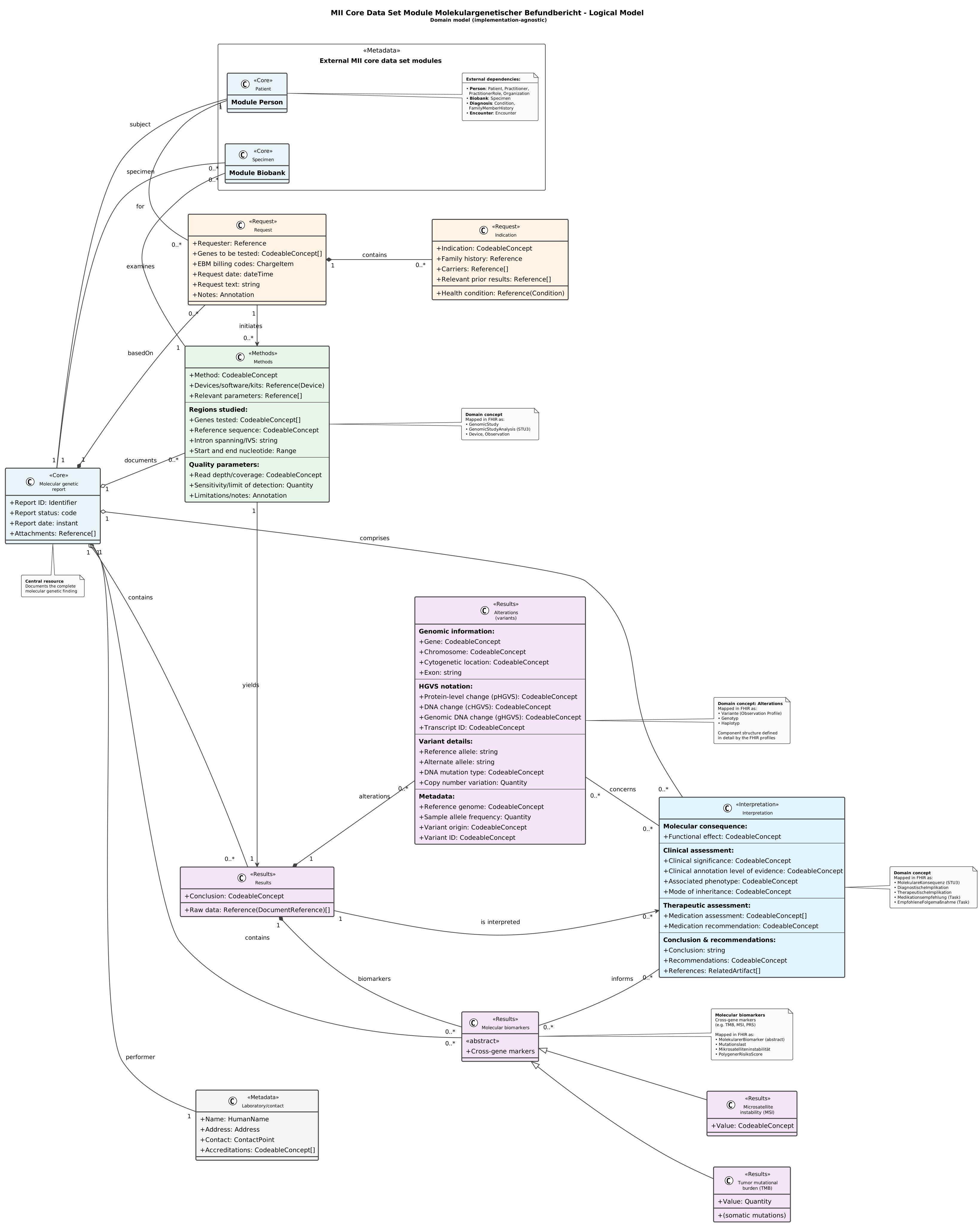
The logical data models of the Molekulargenetischer Befundbericht module describe the domain dataset independently of its concrete FHIR representation.
The data elements in the Indication / Request area describe the objective of the requested examination and the relevant context, including previously performed tests and, where applicable, already known familial predispositions.
The data elements described in the Methods section cover sequence-based analytical methods.
Based on the analysis, statements about the results obtained are made in Results.
Finally, the results are evaluated and interpreted in the Interpretation / Expert opinion area.
The thematic grouping Other / Formal holds additional remarks, information about the laboratory performing the test, and billing-relevant data.
The complete list of dataset elements with their path and the corresponding explanation is available in the element dictionary on the artifact page of the logical model; the IG Publisher generates that view automatically from the StructureDefinition.
The class diagram below shows the same model as an overview: which domain concepts exist, how they relate, and — in the notes along the edge — which FHIR artefacts of this module realise them. It is deliberately implementation-agnostic: data types and cardinalities here are orientation, not obligation. What binds is what the profiles state.
The source is kept as PlantUML in the repository. It is split into a language-neutral
structure (input/images-source/logical-model-domain.iuml) and one label file per
language, so the German and English renderings cannot drift apart structurally.