

MII IG Kerndatensatz-Modul Onkologie
2027.0.0-ballot.1 -
Germany
MII IG Kerndatensatz-Modul Onkologie
2027.0.0-ballot.1 -
Germany
This page is part of the MII IG Kerndatensatz-Modul Onkologie (v2027.0.0-ballot.1: Release) based on FHIR (HL7® FHIR® Standard) R4. This is the current published version in its permanent home (it will always be available at this URL). For a full list of available versions, see the Directory of published versions
This comprehensive example demonstrates the complete TNM staging journey of a breast cancer patient across five critical points in time. It illustrates the complexity of real-world oncological assessment and shows how the FHIR architecture, with linked Observations, represents clinical reality.
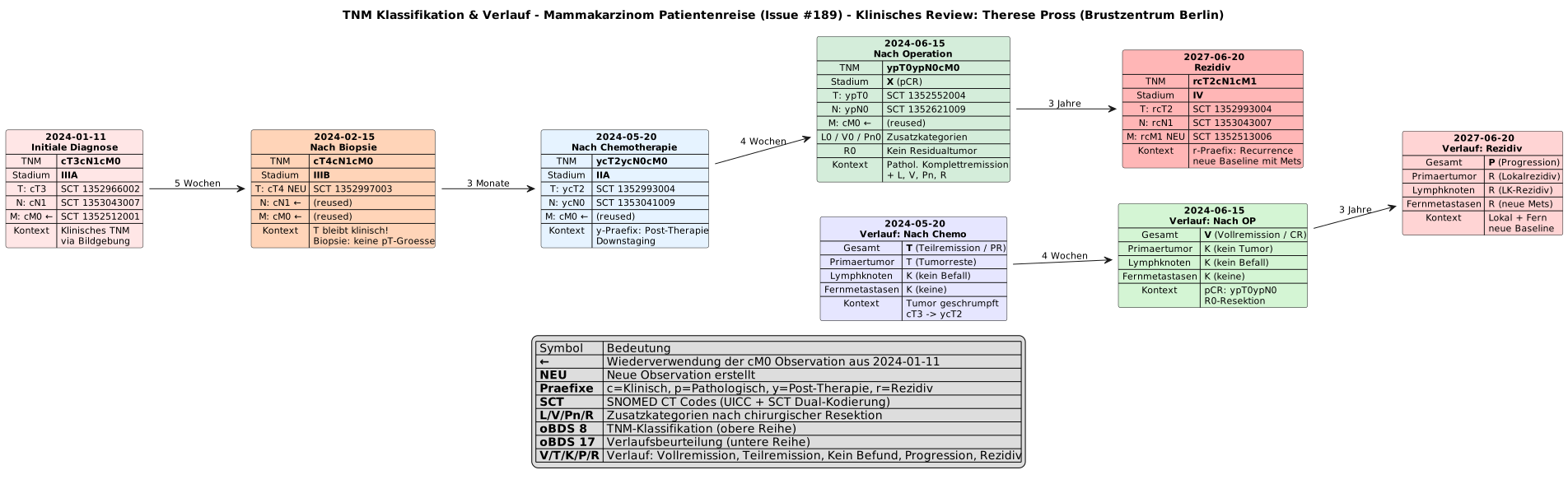
The image is provided as
.svgand can be opened and downloaded separately for a better view: TNM_Breast_Cancer_Journey.svg.
The patient passes through the following staging phases:
| Point in time | TNM stage | Description | UICC stage |
|---|---|---|---|
| January 2024 | cT3N1M0 | Initial clinical assessment | Stage IIIA |
| February 2024 | pT4cN1cM0 | After biopsy - mixed assessment | Stage IIIB |
| May 2024 | ycT2ycN0cM0 | After neoadjuvant chemotherapy | Stage IIA |
| June 2024 | ypT0ypN0cM0 | After surgery - complete pathological remission | Complete Response |
| June 2027 | rcT2N1M1 | Recurrence after 3 years disease-free interval | Stage IV |
The initial cM0 Observation (January 2024) is referenced in several later classifications:
This shows that not all TNM categories need to be reassessed at every staging phase.
The example pT4cN1cM0 demonstrates a common clinical situation:
Category-level prefixes (c/p):
Classification-level prefixes (y/r):
y: post-neoadjuvant therapy assessmentr: recurrence staging after a disease-free intervalEach TNM category carries two codings:
T3, N1, M0)Example for cT3:
* valueCodeableConcept = $UICC#T3 "T3"
* valueCodeableConcept.coding[+] = $SCT#1352966002 "Union for International Cancer Control cT3 (qualifier value)"
Using hasMember instead of component allows:
effectiveDateTimeComponents cannot:
mii-pr-onko-tnm-klassifikation (main TNM grouping)mii-pr-onko-tnm-t-kategorie (T categories)mii-pr-onko-tnm-n-kategorie (N categories)mii-pr-onko-tnm-m-kategorie (M categories)mii-ex-onko-tnm-cp-praefix: for c/p prefixesmii-ex-onko-tnm-y-praefix: for post-therapy markingmii-ex-onko-tnm-r-praefix: for recurrence markingThe five staging time points are shipped as separate example instances; the structure view is found on the respective artefact page:
The full JSON and XML representation is available on each instance's artefact page:
This example structure was developed to represent the following clinical realities:
mii-cm-onko-tnm-uicc-sct-clinical and mii-cm-onko-tnm-uicc-sct-pathological contain all mappingseffectiveDateTime of each component should reflect the actual time of assessmentThis example demonstrates the full flexibility and expressiveness of the MII Onkologie TNM profiles. It shows how the FHIR architecture can precisely represent the complex reality of oncological staging processes while at the same time ensuring data integrity and reusability.