

MII IG Kerndatensatz-Modul Seltene Erkrankungen
2027.0.0-ballot -
Germany
MII IG Kerndatensatz-Modul Seltene Erkrankungen
2027.0.0-ballot -
Germany
This page is part of the MII Implementation Guide Seltene Erkrankungen (v2027.0.0-ballot: 2027 Ballot 1) based on FHIR (HL7® FHIR® Standard) R4. This is the current published version in its permanent home (it will always be available at this URL). For a full list of available versions, see the Directory of published versions
In the modeling of rare diseases we distinguish between two kinds of diagnosis:
MII_PR_Seltene_ClinicalDiagnosis) — based on phenotypic featuresMII_PR_Seltene_GeneticDiagnosis) — molecularly confirmedThis distinction is important because many rare diseases are first suspected clinically and later confirmed genetically.
The clinical diagnosis is used when:
code.coding[hpo] (0..*), required-bound to the
HPO phenotype code value setcondition-ver-status); "provisional" or "differential" are recommended
while genetic confirmation is pendingcategory is mandatory (1..) but its value is not fixed — typically
problem-list-item or encounter-diagnosis. Why the genetic diagnosis handles this
differently is explained below under *Why the category differs.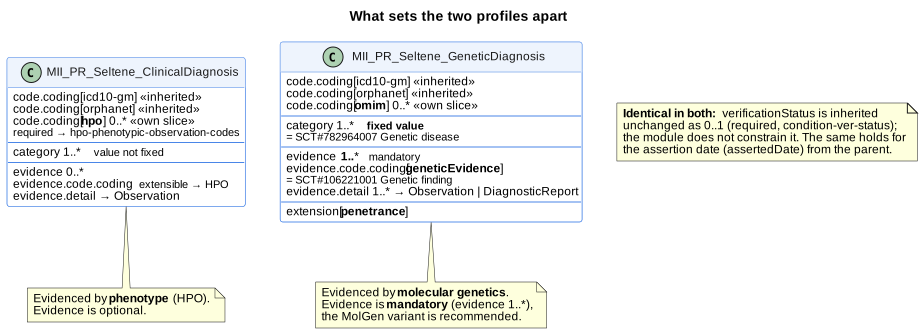
The spelled-out instances live with the profiles themselves; what matters here is the difference, not the syntax.
The genetic diagnosis is used when:
evidence is mandatory (1..), evidence.detail (1..) references
an Observation or DiagnosticReport. The profile does not constrain the target profiles;
the MolGen resources are recommended:
MII_PR_MolGen_Variante for individual variantsMII_PR_MolGen_DiagnostischeImplikation for comprehensive genetic reportsevidence.code.coding[geneticEvidence] carries
106221001 | Genetic finding |penetrance extension782964007 | Genetic disease | for unambiguous labelingThe two profiles treat category differently, and that deserves an explanation:
category |
|
|---|---|
| Clinical diagnosis | mandatory, value free |
| Genetic diagnosis | mandatory, fixed value 782964007 \| Genetic disease \| |
In FHIR, Condition.category answers the question of the condition's role in the
record — the element's short text reads literally problem-list-item |
encounter-diagnosis. The kind of disease belongs in Condition.code.
The clinical diagnosis follows that: it requires a category but prescribes no value. The genetic diagnosis additionally fixes a code — deliberately, for two reasons.
It is permitted. Condition.category is 0..* and bound extensibly to
condition-category. An extensible binding explicitly allows codes outside the value set
where none of them fits; FHIR itself notes on the element that the categorization is
"often highly contextual".
It is needed. Whether a disease is genetically confirmed is not stated in
Condition.code — that carries the disease itself — and cannot be derived from it,
because the same disease may be confirmed clinically or genetically. The module carries
that distinction in two separate profiles; category makes it searchable across
registries.
To be distinguished from the retired value set
mii-vs-seltene-clinical-diagnosis-category: that bound category module-wide to kinds
of disease instead of the record role, and so answered the wrong question. This is a
single, reasoned additional marker.
Open point for the ballot.
patternCodeableConcepton a repeating element requires every repetition to match the pattern. A second category —encounter-diagnosisfor the record role, say — is therefore not currently allowed, and all examples accordingly carry only this one value. An open slice requiring782964007while admitting further categories would be cleaner. That changes the published constraint shape and is therefore put up for comment.
In rare diseases, clinical and genetic diagnoses exist in parallel:
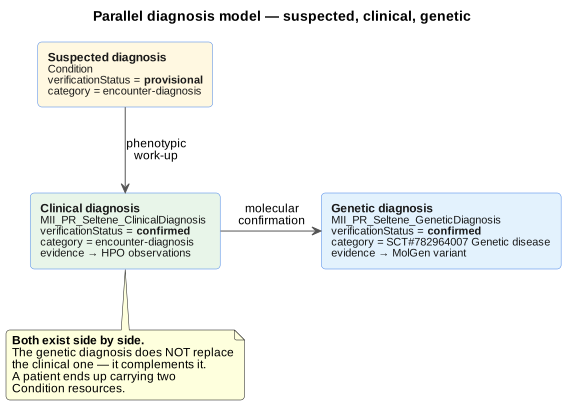
The diagram shows all three stages: the suspected diagnosis from screening or first contact, the clinical diagnosis after phenotypic work-up, and the genetic diagnosis after molecular confirmation.
Important: The genetic diagnosis does NOT replace the clinical diagnosis. Both exist in parallel and complement each other.
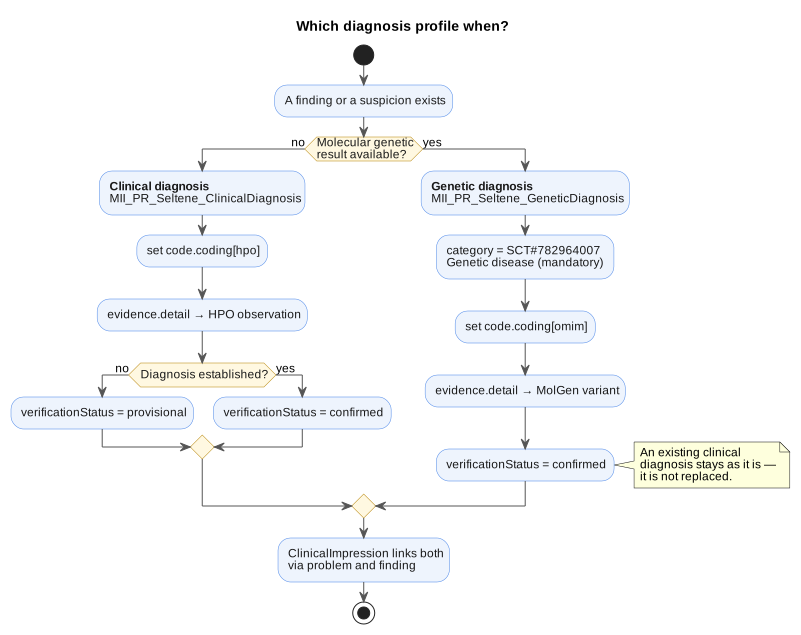
The ClinicalImpression links the stages: problem → suspected diagnosis, finding → clinical diagnosis, finding → genetic diagnosis, investigation → examinations.
| Situation | Profile | Verification status |
|---|---|---|
| Newborn screening positive | ClinicalDiagnosis | unconfirmed |
| Clinically unambiguous syndrome | ClinicalDiagnosis | provisional |
| Genetically confirmed | GeneticDiagnosis | confirmed |
| Clinically + genetically confirmed | Both profiles in parallel | confirmed |
| Excluded diagnosis | Corresponding profile | refuted |
| Differential diagnosis | ClinicalDiagnosis | differential |
The ClinicalImpression links the different diagnostic stages:
Both diagnoses remain as independent resources and document different aspects of the same disease.
Clinical diagnosis:
Genetic diagnosis:
category set — mandatory (1..*)code.coding[hpo] where the phenotype is known (the profile does not
enforce it, but for rare diseases it carries the actual content)evidence.detail referencing phenotypic observationsverificationStatuscategory = 782964007 | Genetic disease | — mandatory, fixed valueevidence with evidence.detail — mandatory (1..*)evidence.code.coding[geneticEvidence] = 106221001 | Genetic finding |verificationStatus = confirmed for a confirmed diagnosisExcluded diagnoses (refuted) MUST also be documented!
For rare diseases, the documentation of excluded diagnoses is essential for:
Excluded diagnoses use the same profile as confirmed ones; only the status differs:
| Field | Clinically excluded | Genetically excluded |
|---|---|---|
| Profile | MII_PR_Seltene_ClinicalDiagnosis |
MII_PR_Seltene_GeneticDiagnosis |
verificationStatus |
refuted |
refuted |
clinicalStatus |
inactive |
inactive |
| Justification | note.text |
note.text |
| Evidence | negative phenotypic finding | negative molecular finding |
verificationStatus = refutedclinicalStatus = inactivenote.textrecordedDate: when it was excludedabatementDateTime: time of exclusionComplete examples can be found in: